

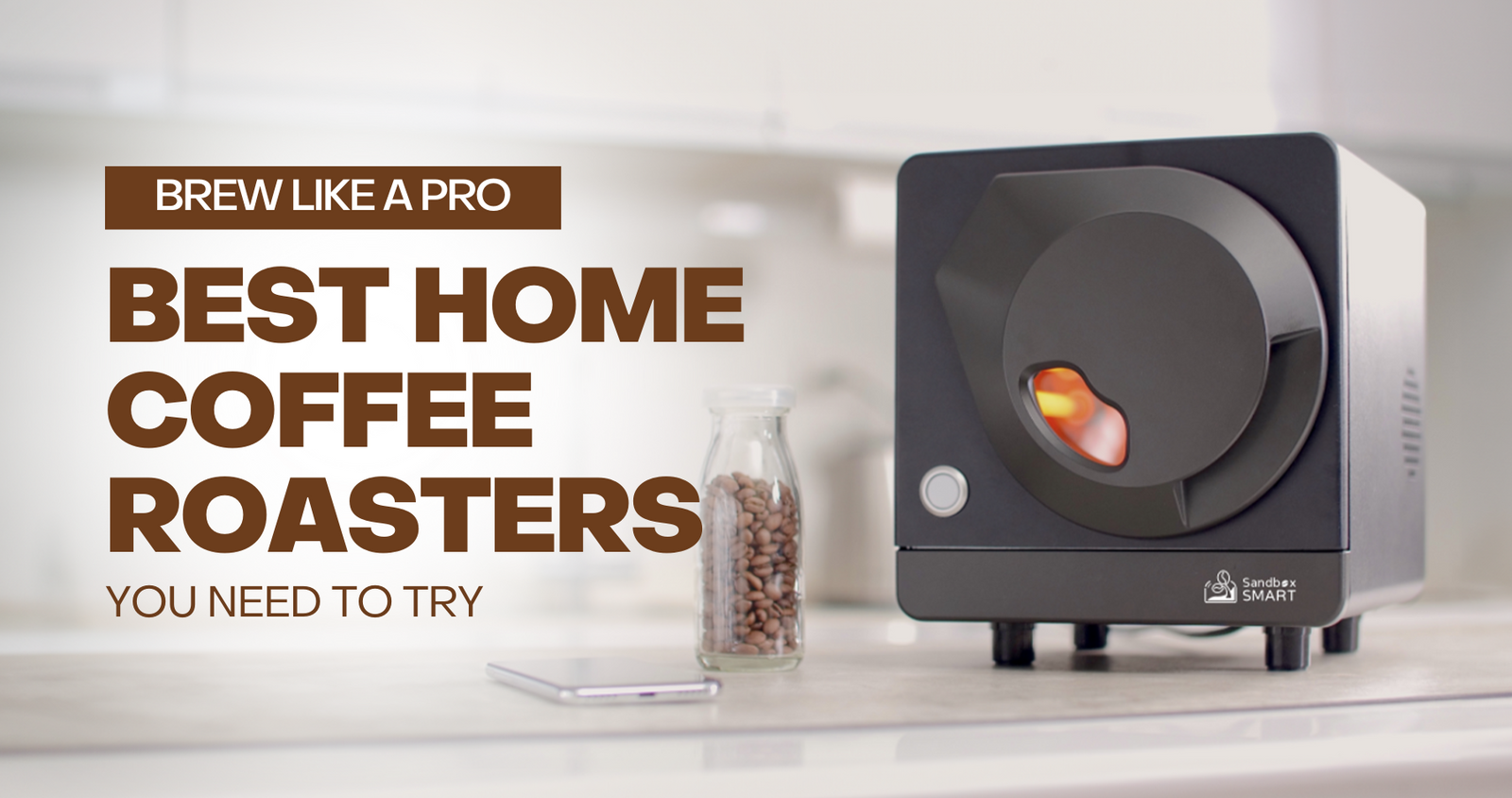

Quick answer: For most beginners, the Fresh Roast SR800 air roaster (226 g batch, ~8 minutes) is the highest-confidence first machine: cheap parts, transparent controls, forgiving learning curve. Step up to the Sandbox Smart R1 drum (100–150 g, app-controlled) once you want repeatable profiles and a logged roast curve. Anything heavier than a 1 lb batch is no longer "home" territory.
Most "best home roaster" lists rank machines by feature count. That is the wrong axis. What actually separates a usable home roaster from an expensive paperweight is whether you can hit a repeatable rate-of-rise curve, hear first crack, and cool the beans fast enough to stop development on time. Everything else (color choices, Bluetooth modes, smart-home integration) is downstream of those three jobs.
What "best" actually means here
Three measurable jobs define a good home coffee roaster:
- Repeatable rate of rise (RoR). RoR is the bean temperature derivative, degrees per minute. A good machine lets you replay the same heat curve on Tuesday that you ran on Sunday. Cheap roasters drift because their fan motor lacks variable-speed control or because the bean-temp probe sits in the airflow instead of touching the bean mass.
- Audible first crack. First crack (the audible pop as cell walls rupture, roughly 196 °C / 385 °F at the bean surface) is the most reliable signal you have. If the roaster's fan or motor is louder than 70 dB at the operator's ear, you will mistime your drop. Quieter is not luxury; it is the difference between a 22% development time ratio (DTR) and a 35% one.
- Cooling speed. Beans keep roasting on residual heat for 60–90 seconds after the drop. A roaster with a slow cooling tray hands you over-developed beans whether you wanted them or not.
Every machine below is scored against those three jobs, not against the spec sheet. Where we have spec numbers, they are from CRC's product pages or the manufacturer documentation, cross-checked on 2026-05-11. Where the public spec disagrees with operator-reported behavior on the Home-Barista forum or r/roasting, we say so.
Air, drum, and ceramic: how home roasters actually differ
Three operating principles dominate the home-roaster catalog. Understanding which you are buying is more useful than memorizing brand names.
Air (fluid-bed) roasters
Hot air both heats and agitates the bean mass. Fresh Roast SR800, Kaffa Wide POP, and the discontinued Hottop FB-2K are examples. Air roasters heat fastest, produce the cleanest cup with washed Kenyan and Ethiopian Yirgacheffe origins, and are the easiest first machine to learn on. Trade-off: small batches (typically 70–300 g) and limited Maillard-window control because the airflow drives both convection and bean motion. You can change one or the other, not both independently.
Drum roasters
A rotating metal drum tumbles the beans over a heat source. Sandbox Smart R1, Gene Cafe CBR-101, Behmor 1600 (and its newer 2000AB Plus), Hottop KN-8828B-2K+, and the Aillio Bullet R1 all use this principle, though they implement it very differently. Drum roasters develop bigger body, longer Maillard reactions, and forgive natural and honey-processed beans that crash an air roaster's curve. Trade-off: heavier, slower, more expensive, and the drum-temp probe drifts as roasting oils coat it.
Manual ceramic and stovetop roasters
The Zenroast and similar Japanese stovetop ceramics give you 50–70 g batches with full manual control and zero electronics. They are excellent for learning what first crack sounds and smells like before you commit to a $700+ machine. They are not a substitute for an electric roaster if you plan to roast more than once a week.
Seven home roasters worth a serious look
1. Fresh Roast SR800: the default first machine
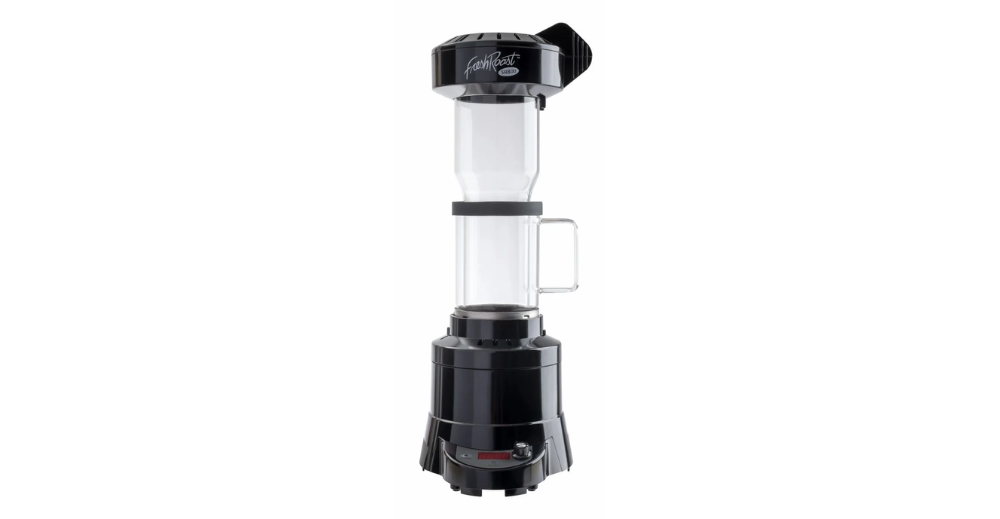
If you have never roasted before and you want one machine that will not punish you for mistakes, this is it. The SR800 is a fluid-bed air roaster with separately adjustable heat and fan, a real-time temperature readout on the knob-based control panel, and a stated 226 g (8 oz) capacity for wet-processed (washed) beans. Drop to 170 g for naturals because the extra chaff overwhelms the filter at full load.
Why it earns the first slot: parts are cheap, the troubleshooting community is enormous, and the control surface teaches you what each input does without hiding it behind an app. You will hear first crack clearly at fan speed 5–7, which is where most washed Ethiopian Sidamo or Guatemalan Huehuetenango lots want to live. Total roast time runs 8–10 minutes for a City+ to Full City roast.
Failure mode to know: the chaff collector clogs aggressively on dry-processed beans and on second-crack roasts. Pull the unit, brush the screen, and check fan blade balance every 20 batches or you will fight inconsistent RoR for reasons that have nothing to do with your profile. Fresh Beans Inc. covers manufacturing defects under a 1-year base-unit warranty.
If 226 g is too much, the smaller SR540 uses the same control logic in a 113 g chassis. Same learning curve, smaller batches, lower entry price.
2. Zenroast ceramic stovetop roaster
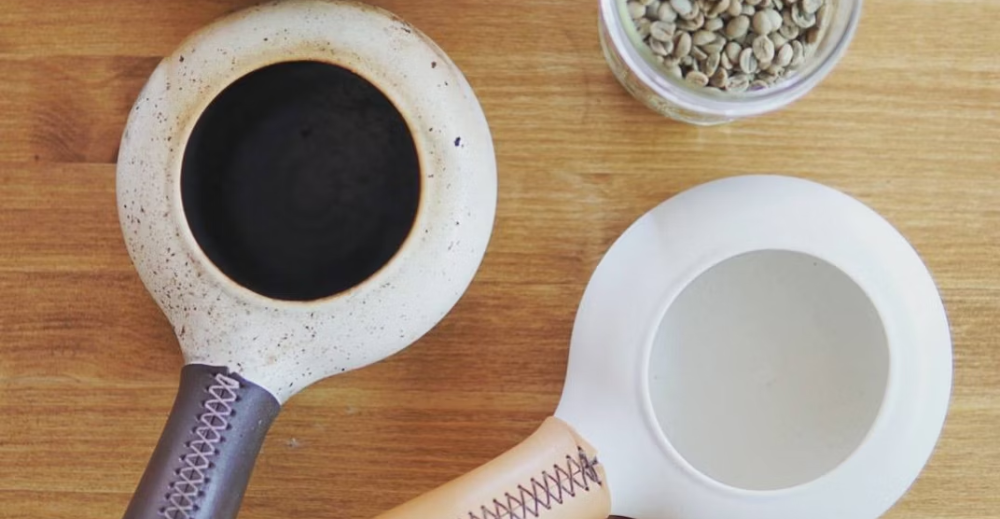
A Japanese-made ceramic vessel that holds about 70 g of greens and rides on a gas or electric burner. You agitate by rocking it manually. Roast time runs 10–15 minutes depending on flame height and ambient temperature. There is no probe, no display, no automation.
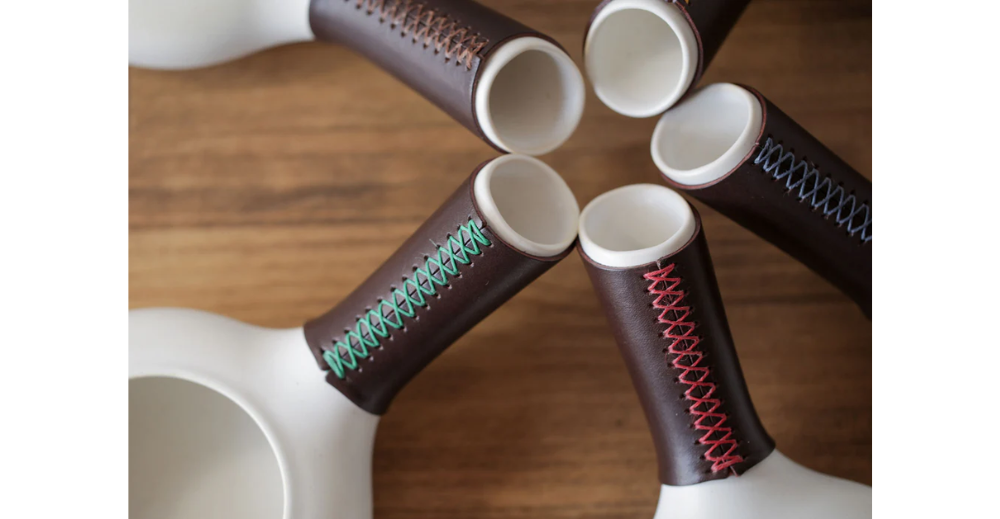
Why it earns a slot anyway: it forces you to develop the two senses that matter most. You hear first crack at around 9–11 minutes. You watch the color shift from grass-green through yellow, tan, light brown, and into the chocolate-brown City roast window. After 20 batches on a Zenroast, you will read an electric roaster's curve faster than a beginner who skipped this step.
Failure mode to know: ambient temperature matters more than people expect. A 10 °C kitchen in January adds 90+ seconds to the same recipe you nailed in July. Not safe for induction stoves or microwaves; gas and resistive electric only. Cross-brand comparator: the Nuvo Eco and Bohemia 250 occupy the same category if you cannot source a Zenroast.
3. Kaffa Wide POP
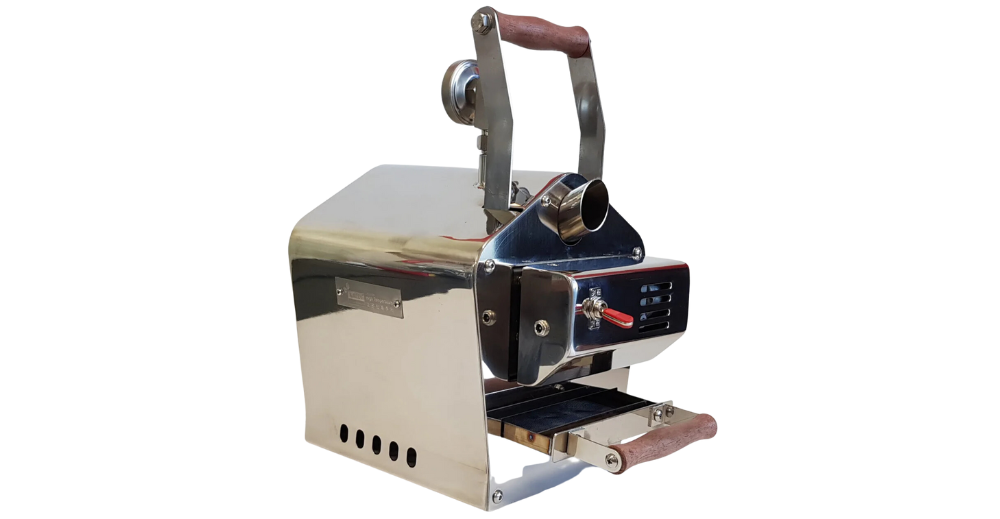
A South Korean electric air roaster sitting between the SR540 and SR800 in capacity (150 g) and price. The Kaffa Wide POP has a wider roasting chamber than a typical popper-style unit, which lets the bean bed run shallower and crack more uniformly. Built-in temperature display, manual fan and heat controls, indoor use only.
Why it earns a slot: this is the right machine for someone who outgrew a popcorn-popper conversion but does not want to commit to a drum. The wider chamber matters more than the marketing implies. Flat beans like Bourbon and SL28 from Nyeri County tumble more evenly here than they do in a narrow column. Roast time runs 10–15 minutes.
Failure mode to know: the standard chaff collector fills in 5–7 batches on dry-processed beans. The Kaffa Wide POP Chaff Collector accessory triples capacity and is worth the add-on for anyone planning back-to-back roasting sessions. If you need a step up, the Kaffa Wide400 handles 400 g batches with its own integrated cooler.
4. Gene Cafe CBR-101
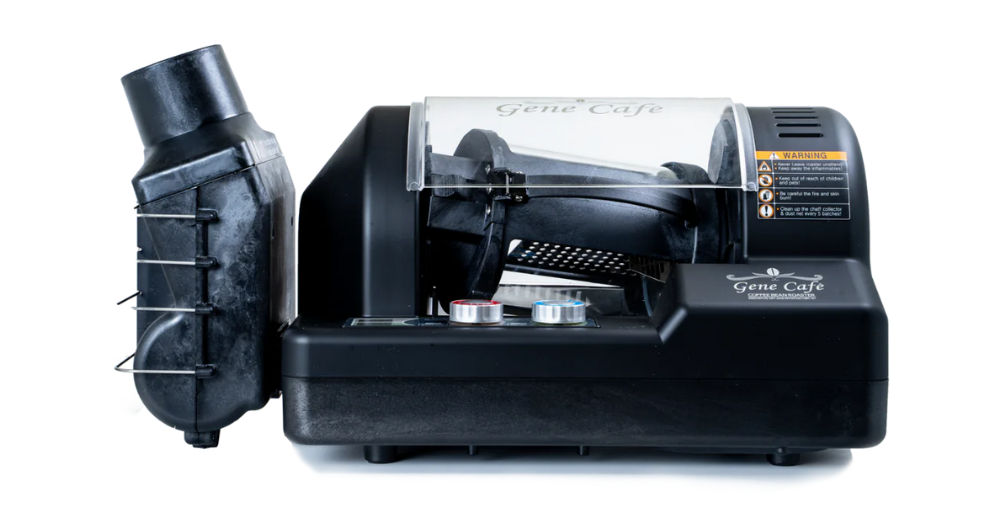
In production since 2003, the Gene Cafe uses an off-axis rotating drum that wobbles the beans rather than tumbling them. The Pyrex viewing window is the largest in the home-roaster segment, which matters more than it sounds when you are reading bean color in real time. Adjustable temperature and time, LED control readout, 226 g (8 oz) batch capacity.
Why it earns a slot: it is the most operator-friendly drum roaster under $1,000. The chaff collector connects to an exhaust port that you can vent out a window, which solves the indoor-smoke problem that kills enthusiasm for most drum machines.
Failure modes to know: the unit is physically large (49 cm wide). Heat-up takes longer than published, so plan a 4-minute pre-heat before charging beans or your first roast will run cold. The off-axis drum drives a quirky thermal profile. The rate-of-rise curve here does not transfer cleanly to a conventional drum if you later upgrade. Cross-brand comparator: the Behmor 1600 Plus uses a more conventional drum geometry and may be a better stepping stone toward a commercial Probat or Diedrich layout.
5. Sandbox Smart R1: when you want a logged roast curve

The Sandbox Smart R1 is a Taiwan-built compact drum roaster with three quartz infrared heating elements and a Bluetooth app interface. CRC's product page lists a 100 g (0.22 lb) batch capacity; the manufacturer specs allow up to 150 g, and operator reports on the Home-Barista forum show usable roasts up to about 5 oz on the high end. Roast time runs 9–16 minutes depending on profile.
Why it earns a slot: this is the cheapest machine in the home-roaster catalog that gives you a logged, reproducible RoR curve. Auto mode comes with pre-built profiles for washed and natural processed origins. Manual mode unlocks independent control of heat, fan speed, and drum RPM, which is where someone serious about replicating an Ethiopian Yirgacheffe Kochere profile across batches will spend most of their time. Bundle it with the Sandbox Smart C1 cooler for full-cycle bean management.
Failure modes to know: Bluetooth pairing drops on iOS 18+ in some installs and requires a power-cycle and re-pair sequence; the workflow is documented in Sandbox's support knowledge base. The The 100 g batch ceiling is real. Push past 150 g and you will see drum-temp probe drift as bean mass dampens the infrared response. The R1 is not silent during operation; quartz elements create an audible hum that masks first crack on dark roasts unless you are paying close attention.
If 100–150 g is too small, the Sandbox Smart R2 doubles capacity and adds a heavier drum mass that holds Maillard-window heat better. Cross-brand comparator: the Aillio Bullet R1 (CRC does not carry) is the dominant 1 kg-class home drum and represents the natural ceiling of the "home" segment before you cross into commercial territory.
6. Behmor 2000AB Plus
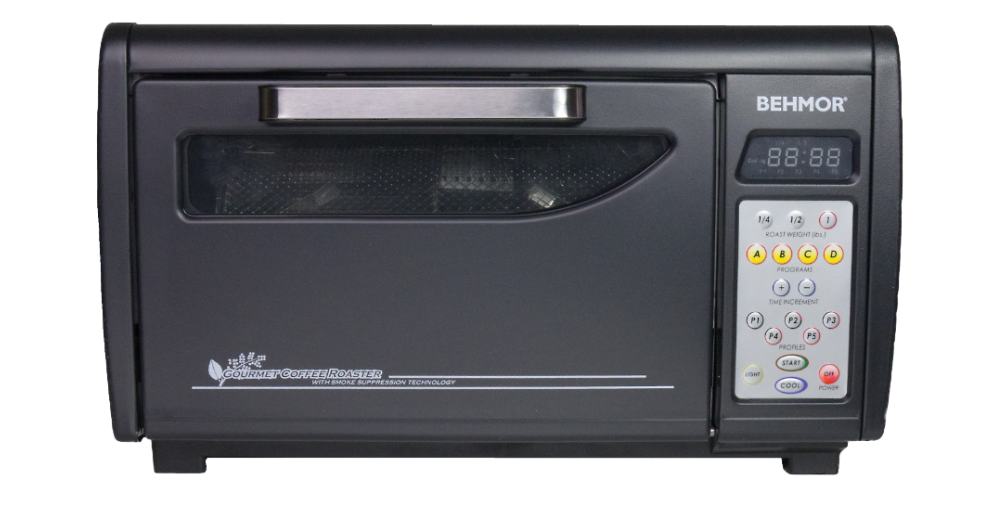
Behmor's flagship US-built drum roaster handles up to 454 g (1 lb) per batch, which makes it the volume leader in the home-roaster bracket. Double-paned glass for heat retention, dual-speed drum motor (16/32 RPM), smoke-suppression mode (effectively a catalytic afterburner) for indoor use, pre-programmed profiles plus a manual mode.
Why it might earn a slot: if your household actually drinks 1 lb of fresh-roasted coffee per week or more, this is the right tool. Smoke suppression lets you roast medium-dark to dark indoors without setting off smoke detectors. Roast time runs 12–20 minutes.
Failure modes to know: the smoke-suppression catalyst needs replacement every 200–300 batches and degrades unpredictably in between. The 16 RPM mode produces more drum-temp probe drift than the 32 RPM mode because beans clump rather than tumble. And the 1 lb capacity bleeds over. You can physically load 1.25 lb, but the heating element will not reach Maillard window in time and you will end up with under-developed beans. Behmor is not stocked at CoffeeRoast Co. as of 2026-05-11; we mention it because the catalog gap matters. Cross-brand comparator: the Hottop KN-8828B-2K+ occupies the same price tier with a smaller batch but a more transparent control surface.
7. Kaffa Mini
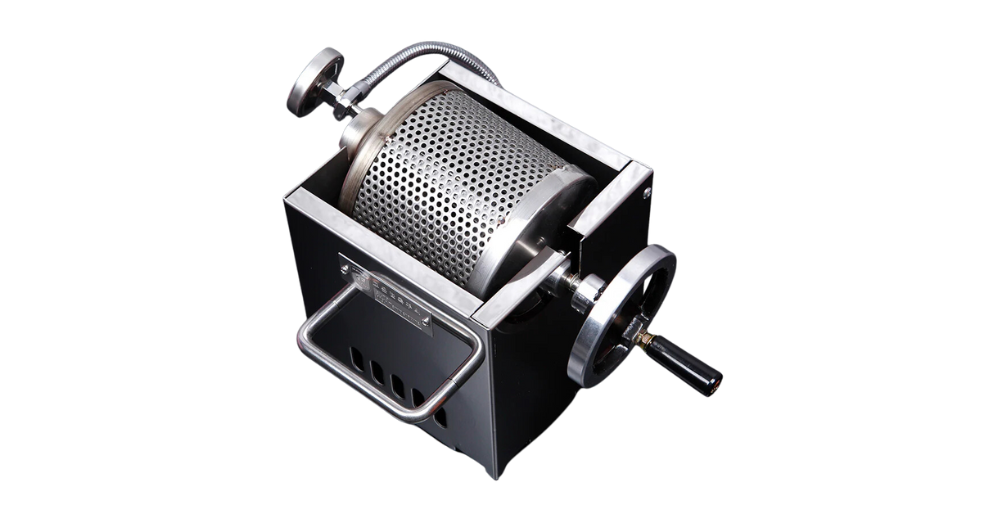
A small drum roaster with a gas-burner heat source (not electric, despite the source article's spec sheet; confirm the variant before purchase). 226 g (8 oz) capacity, stainless steel drum, manual or motorized variants. Roast time runs 10–20 minutes depending on burner output and ambient.
Why it earns a slot: if you already have a propane burner and want drum-style heat with no learning curve, the Kaffa Mini is the cheapest way in. Stainless construction tolerates the heat soak that destroys plastic-housed roasters over time.
Failure modes to know: there is no automation. You manage flame height, drum RPM (in the motorized variant), and time. Two batches in a row will land different roast levels unless you stabilize the burner first. This is feature for someone learning drum behavior; it is a problem if you want consistency on autopilot.
Failure modes the marketing copy never mentions
Four operator-reported issues show up across the home-roaster bracket regardless of brand. They are worth pricing in before you buy.
Drum-temp probe drift. The bean-temperature probe is usually a K-type thermocouple in direct contact with bean mass. Roasting oils coat it over time. After 100 batches the same input current produces a 5–8 °F lower reading. Solution: clean the probe weekly with a mild solvent (Behmor and Sandbox both publish instructions); do not just wipe it. If you ignore this, your "same profile" will keep getting darker.
Batch-size bleed-over. Every drum roaster has a stated max load. Most also have a "real" max, typically 110–115% of stated, beyond which the heating element cannot hit Maillard window in time. The SR800 caps at 226 g for washed and 170 g for naturals because of this. The Sandbox R1's 100 g spec is a hard ceiling for the same reason, even though the chamber will physically hold 150 g.
Ambient-temperature roast-curve impact. A 10 °C kitchen in January will add 30–90 seconds to the same recipe you ran at 22 °C in July. Hottop, Aillio Bullet, and Behmor users compensate by extending pre-heat. Air roasters compensate less well because the fan is also doing thermal work. If you roast year-round in an unheated garage, plan profiles per season.
Firmware and app dependency. Sandbox, Aillio Bullet, and the newer Kaleido machines all depend on an iOS/Android app for profile management. App updates occasionally break workflows, and a dead phone mid-roast becomes a problem if you have not memorized your manual-mode equivalents. Keep a printed backup of your two or three favorite profiles taped to the wall above the roaster.
Picking a roaster by use case
Beginner, one cup a day, indoor kitchen: Fresh Roast SR540 or SR800. Forgiving controls, fast learning curve, cheap to repair.
Hobbyist, 2–3 cups a day, willing to learn a curve: Sandbox Smart R1 with the C1 cooler. App logging shortens the path to replicable profiles by months compared to a manual machine.
Serious home roaster, 1 lb+ per week, indoor only: Behmor 2000AB Plus or Hottop KN-8828B-2K+ (cross-brand). For higher volumes still, look at the Kaleido M10 (1.2 kg drum) on the Kaleido US collection, the boundary between "home" and "micro-roaster" and where the Aillio Bullet R1 also sits.
Outdoor roasting, no smoke management: Kaffa Mini with a propane burner. Manual control, no app dependency, easy to clean.
Learning what first crack sounds like: Zenroast or any stovetop ceramic. Use it for the first 20 batches, then upgrade. The skill transfers.
For the full lineup, browse the home coffee roasters collection or compare the broader inventory of home and commercial roasters.
Home coffee roaster FAQ
What is the smallest batch size I can roast with reliable consistency?
About 50 g on a drum, 70 g on an air roaster. Below that, the bean mass is too small to dampen thermal swings. The heating element overshoots, drum-temp probe lags, and your rate-of-rise curve becomes noise. The Zenroast and similar manual ceramics can run 30–50 g batches because human-driven agitation is more responsive than a motor, but at the cost of consistency between batches.
Does ambient temperature actually affect my roast curve enough to matter?
Yes. A 10 °C swing in kitchen temperature shifts first crack by 30–90 seconds and changes total roast time by 5–10%. Operators who roast year-round either heat the roasting space to a stable temperature or keep separate "summer" and "winter" profile presets. Cold-start mass (the roaster body and drum at ambient temperature) also matters; the first batch of the day tends to run slower than the second by 30–45 seconds.
Can I roast coffee indoors without venting?
Maybe, but plan around it. Light roasts (City, City+) emit less smoke than dark roasts (Vienna, French, Italian). Air roasters smoke less than drum roasters at the same roast level. Smoke-suppression machines like the Behmor 2000AB Plus can handle dark roasts indoors. For everyone else, the standard practice is a kitchen with an active range hood, an exhaust vent to a window, or roasting in a garage or covered porch. Smoke detectors near the roaster will trip during the final 60 seconds of a Full City+ or darker roast.
How long do home-roasted beans stay fresh?
Roasted beans peak between 5 and 14 days after the roast: long enough for CO₂ to degas without staling. Stored in an opaque, one-way-valve container at room temperature, they hold acceptably for about 30 days. Past that, aromatic compounds degrade audibly in the cup. Green (unroasted) beans hold for 12+ months if stored cool and dry, which is why most home roasters keep 5 lb of greens and 1 lb of roasted at any given time.
Air roaster or drum roaster for a first machine?
Air, for almost everyone. Air roasters are cheaper, faster, easier to clean, and more forgiving when you mistime a profile. Drum roasters reward technique that you have not built yet on machine #1. Most operators who start with a drum end up buying an air roaster anyway for fast-turnaround sample batches. Reverse that order and you save money and learn faster.
How loud are home coffee roasters?
Modern home roasters run between 55 and 70 dB at operator distance, roughly between a refrigerator and a dishwasher. Air roasters tend to run louder than drums because the fan does both heating and agitation. Quieter is not just a comfort feature; if the machine masks the audible pop of first crack, you will mistime your drop and over- or under-develop the beans.
What does a home coffee roaster actually cost?
Entry-tier (Fresh Roast SR540, Zenroast, Kaffa Mini) runs $100–$300. Mid-tier (SR800, Kaffa Wide POP, Behmor 1600) runs $400–$800. Serious home tier (Sandbox Smart R1 with cooler, Gene Cafe, Behmor 2000AB Plus) runs $700–$1,500. Beyond $2,000 you are crossing into micro-roaster territory (Aillio Bullet R1, Kaleido M10), which can roast home volumes but is engineered for higher batch counts than most households need.
For the methodology behind these picks, see our companion guides on the coffee bean roasting curve, the air vs drum roaster comparison, and common coffee roasting mistakes to avoid. If you are still picking out green beans, our guide to choosing green beans covers cultivar and processing trade-offs.
Article reviewed by the CoffeeRoast Co. Editorial Team. Primary references are cited inline. We update content quarterly; freshness anchors are the SCA Standards index (2024 revision) and current manufacturer specifications. Last reviewed: May 2026.


Yeung Kingsley
septiembre 04, 2025
Hi, can I buy a roasting machine and ship it to Canada?