

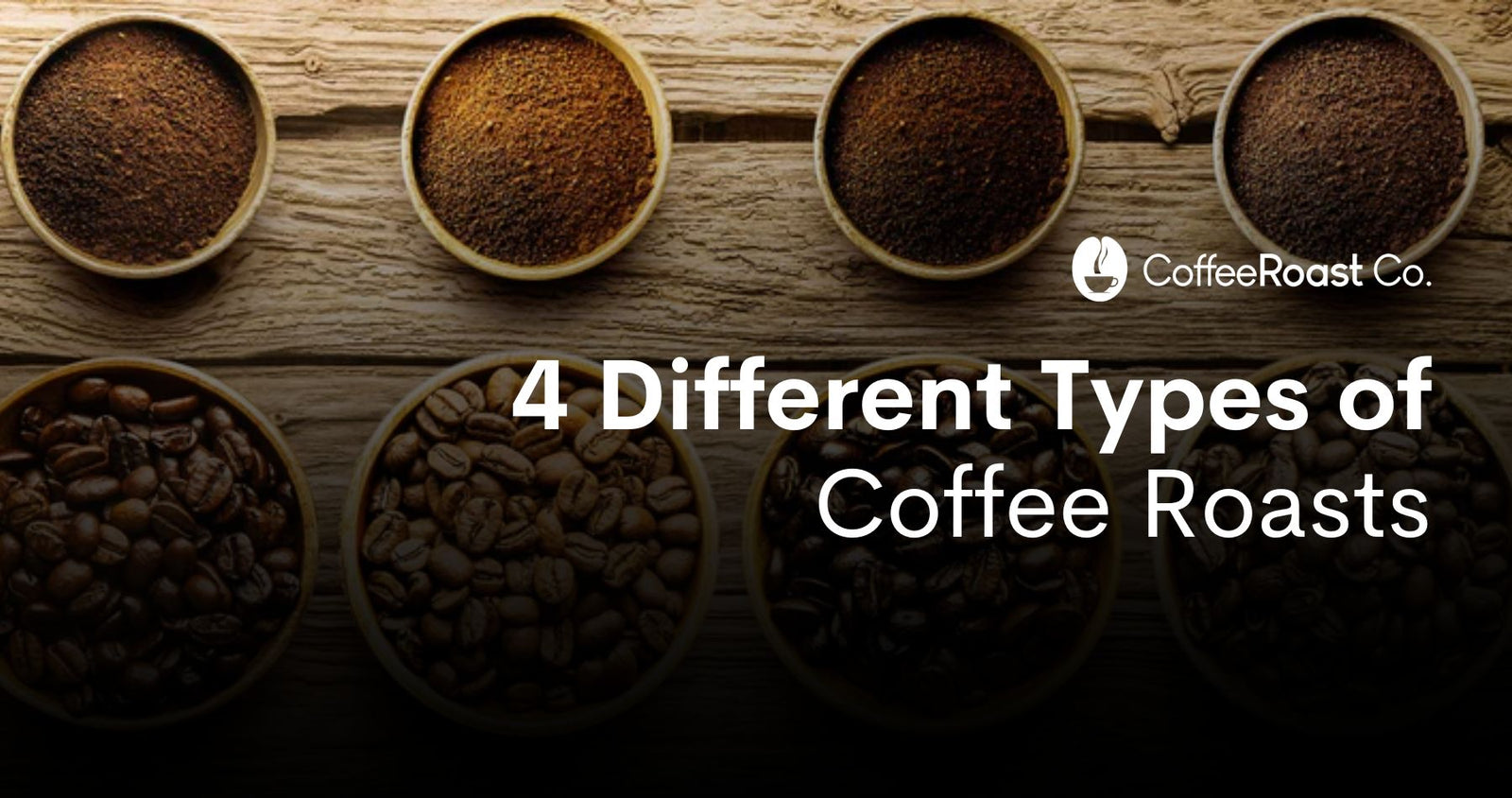

Quick answer: There are four coffee roast types: light (356–401°F, highest caffeine by weight, bright acidity), medium (410–428°F, balanced body), medium-dark (437–446°F, bittersweet, surface oils visible), and dark (464–482°F, smoky, lowest acidity). Each band changes flavor, body, and caffeine differently. Temperature is the reliable dividing line. Trade names like "Vienna" or "French" are not standardized across the industry.
Bag labels will drive you a little crazy at first. Cinnamon Roast. City. Vienna. French. Italian. Every brand picks its own names, and none of them agree on what those names mean. One roaster's "medium" is another's Full City, and a third just calls it Breakfast Blend. That's not carelessness — roast names were never standardized. What is consistent are the four temperature bands. Learn those and the labels stop mattering.
What makes light roasts different from everything else?
Light-roasted beans top out at 356–401°F. The roaster pulls them shortly after first crack — that audible pop when steam pressure ruptures the bean's cell walls. The surface stays completely dry, no oils, almost chalky to the touch.
Because heat degrades caffeine and burns off chlorogenic acids over time, stopping early means you keep more of both. By weight, light roasts carry more caffeine than dark roasts — though if you scoop by volume instead of using a scale, the gap shrinks fast. Light beans are denser, so a level scoop holds fewer grams than a scoop of dark roast. Weigh your doses if this actually matters to you.
The bigger story at this temperature is origin character. A washed Ethiopian Yirgacheffe tastes nothing like a Kenyan SL28, and neither tastes like a Colombian Castillo, because the roast hasn't flattened those differences yet. Bright citrus, berry, sometimes a floral note that disappears the moment you push the beans any darker.
The catch is that light roasts are unforgiving to brew. They resist extraction. Brew too cool or too coarse and you get something sour and watery instead of bright and complex. If you've ever had a pourover at a specialty shop that tasted like hot lemonade, you were probably drinking a light-roasted single-origin that someone pulled slightly wrong. Grind finer than you think you need to, and push water temperature to 94–96°C. Don't treat it like a supermarket drip blend.
Common names: Cinnamon Roast, New England Roast, Half City, Light City.
Why is medium roast the default for most home brewers?
Medium roasts land between 410–428°F, in the window between first and second crack. The surface is mostly dry, but the bean is a noticeably deeper brown and slightly less dense than a light roast.
This is the roast that built American coffee culture, and it earned that position. Medium roasts develop more body than light roasts without crossing into smoky, bitter territory. Acidity backs off but doesn't disappear. You trade some of that sharp, origin-specific brightness for a rounder sweetness and a result that works consistently across brew methods. Drip, French press, Aeropress — they all behave well here.
If you're buying beans to brew at home and you don't know where to start, an honest medium roast from a roaster you trust is the lowest-risk entry point. You're not fighting the extraction challenges of a light roast or the bitterness ceiling of a dark one. That's not a knock on medium. That's exactly why CoffeeRoast Co. carries more medium-roast offerings than any other tier.
Common names: House Blend, Breakfast Roast, American Roast, City Roast, City+.
When does a medium-dark roast make sense?
At 437–446°F you've crossed into medium-dark territory, right at or just past second crack. This is the first point where oils migrate to the bean's surface — that faint glossy sheen you notice on some whole-bean bags when you pour them into a grinder.
The flavor shifts meaningfully here. Medium-dark roasts trade origin brightness for something bittersweet and heavier. A Vienna Roast or Full City+ in this range tastes less like the farm it came from and more like the roasting process itself: dark chocolate and brown sugar with a slight charred edge. That's not a flaw — it's what a lot of people are actually looking for, especially with espresso. The heavier body cuts through milk and foam in a way a lighter roast won't reliably do.
Common names: Full City Roast, Full City+, Vienna Roast, After Dinner Roast.
Why are dark roasts easier to over-extract than people realize?
Dark roasts push to 464–482°F. By this point the beans are deeply oily, significantly expanded, and noticeably lighter in weight than when they went in. Moisture and CO2 have cooked off. Once you're in French Roast territory around 482°F, origin character is essentially gone. What you taste is the roast's own chemistry: smoky and bittersweetly caramelized, sometimes with an ashy edge.
Dark roasts carry the lowest acidity and the lowest caffeine by weight. Extended roasting time degrades caffeine molecules, and you're working with a lighter, more porous bean that extracts very quickly. That combination makes dark roasts surprisingly easy to over-pull. If you're pulling espresso with a dark roast and getting a sharp, charcoal-heavy finish, try dropping brew temperature 2–3°C and shortening contact time before touching anything else.
Italian Roast pushes even darker and is the dominant style across European espresso traditions. French Roast and Italian Roast got their names from historical preference, not from where the beans originated.
Common names: French Roast, Italian Roast, Espresso Roast, Continental Roast, Spanish Roast.
What does the roasting process actually do to a green bean?
A green coffee bean is just a seed — the seed inside a coffee cherry. Raw, it smells faintly grassy and earthy, nothing like what ends up in your cup. Roasting creates everything you recognize as coffee flavor.
As the bean heats up, moisture evaporates first. Then the Maillard reaction kicks in: amino acids and reducing sugars interact under heat, generating hundreds of flavor and aroma compounds and turning the bean progressively browner. Around 401°F, internal steam pressure ruptures the cell structure — first crack. Around 437°F a second crack follows as CO2 escapes more rapidly. At each stage, acidity drops, bitterness builds, and oils migrate outward toward the surface.
Worth knowing: roast level doesn't save bad coffee. A poorly grown, poorly stored, or old green bean roasted light is still a bad cup. The roast amplifies what's already there. It can't create quality that wasn't present before the bag was sealed.
Quick-reference comparison table
| Roast level | Internal temp | Surface oils | Acidity | Caffeine (by weight) | Common names |
|---|---|---|---|---|---|
| Light | 356–401°F | None | High | Highest | Cinnamon, New England, Half City |
| Medium | 410–428°F | None to trace | Medium | Medium-high | American, Breakfast, City, City+ |
| Medium-dark | 437–446°F | Visible | Low-medium | Medium | Full City+, Vienna, After Dinner |
| Dark | 464–482°F | Heavy | Low | Lowest | French, Italian, Continental, Spanish |
Frequently asked questions
Which roast has the most caffeine?
By weight, light roasts retain slightly more caffeine than dark roasts. Extended roasting degrades caffeine molecules. If you scoop by volume instead of weighing, the gap narrows considerably because dark roasts are less dense and a level scoop holds fewer grams. Weigh your doses if the caffeine difference matters to you.
Does dark roast taste stronger than light roast?
It tastes more intense and bitter, but "stronger" depends on what you're measuring. Light roasts carry more caffeine and more layered, origin-specific flavor. Dark roasts carry less of both and more bitterness. If you want a genuinely stronger cup on caffeine and flavor complexity, a well-brewed light or medium roast at the right brew ratio outperforms a dark one.
What is first crack in coffee roasting?
First crack is the audible popping that happens when internal steam pressure ruptures the bean's cell walls, around 356–401°F depending on the bean. Roasters use it as the primary timing benchmark for light roasts: when to hold and when to pull. Second crack follows around 437°F and signals the start of medium-dark territory.
Why do dark roast beans look oily?
Past about 437°F, the oils inside the bean migrate to the surface. That slick sheen on a bag of dark roast is those oils, and they're also a big part of the aroma when you open the bag. The practical downside: oily beans go stale faster and can gum up burr grinders. If you're running dark roasts daily, clean your burrs more often than you would with a light or medium roast.
What do "Full City" and "Vienna Roast" actually mean?
They're traditional names tied to specific temperature and color ranges. Full City and Full City+ sit in the medium-to-medium-dark window, roughly 428–446°F. Vienna Roast lands on the darker end of medium-dark, around 446–454°F. The names come from historical roasting preferences in those cities, but they're not standardized industry-wide. When in doubt, look at the bean's surface and color.
Are light roasts better for espresso than dark roasts?
It depends on the espresso style you're chasing. Traditional Italian-style espresso uses medium-dark to dark roasts — lower acidity and heavier body hold up through 9-bar extraction and pair well with milk. Specialty third-wave cafes often pull light-to-medium roasts for single-origin shots with more brightness. Light roasts need higher brew temperatures and often pre-infusion to extract cleanly. They're less forgiving on home equipment, so a medium or medium-dark is a more stable place to start.
How can I tell what roast level is in a bag if it doesn't say?
Look at the beans. Light roasts are dry, matte, and medium-brown. Medium roasts are deeper brown, still mostly dry to the touch. Medium-dark roasts show visible surface sheen or patches of oil. Dark roasts are heavily oily and very dark brown, sometimes nearly black. If you're still unsure, smell them before brewing: light roasts carry grain and fruit notes while dark roasts smell smoky and chocolatey from the moment you open the bag.
Key takeaways:
- The four roast levels are light (356–401°F), medium (410–428°F), medium-dark (437–446°F), and dark (464–482°F). Each produces a distinct flavor profile, body, and caffeine level.
- Light roasts retain the most caffeine by weight and the most origin-specific flavor. Dark roasts are lowest in both and highest in bitterness.
- Surface oils first appear at medium-dark. A dry bean surface means you're working with a light or medium roast.
- Roast names like "French," "Vienna," and "City" are not standardized across the industry. Temperature and bean appearance are the reliable reference points.
- Green coffee quality matters as much as roast level. No temperature fixes a poorly sourced or poorly stored bean.


Minani Hamisi
septiembre 04, 2025
I want to take a roasting course