



Quick answer: A drum coffee roaster has 11 core parts: the roasting drum, agitator, burner, gas control valve, drum motor, temperature probe (K-type thermocouple), exhaust system, chaff collector, bean hopper, bean loader, and cooling tray. Each part controls a distinct variable in the roast. The drum and burner determine heat transfer; the thermocouple and control panel govern precision; the chaff collector and exhaust manage safety.
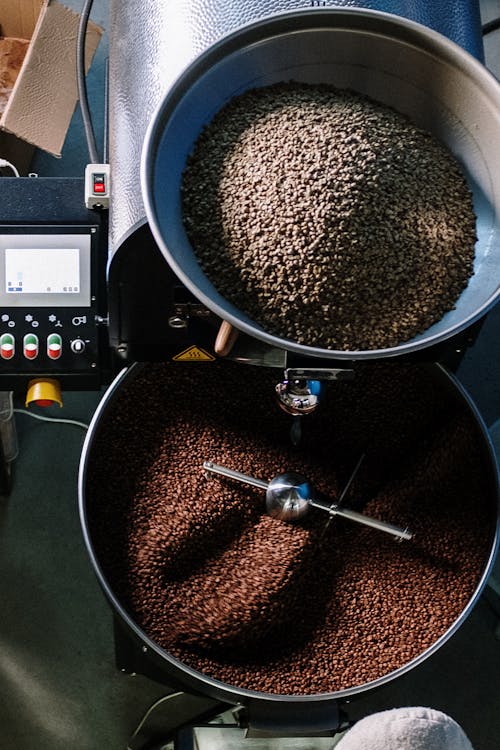

Most people focus on the beans, the roast level, and the flavor profile. The machine itself gets treated like a black box. That's a mistake, because knowing what each component does changes how you troubleshoot a bad batch, how you maintain the machine between sessions, and how you read a roast curve when something goes sideways. This guide covers all 11 parts, what they do, and why each one matters to the cup in your hand.
What controls heat and motion inside a coffee roaster?
Four parts work together to generate heat and keep beans moving: the drum, the burner, the agitator, and the drum motor. Get any one of these wrong and your roast curve collapses. Either you're scorching beans on one side or pulling them out half-developed.
Roasting drum
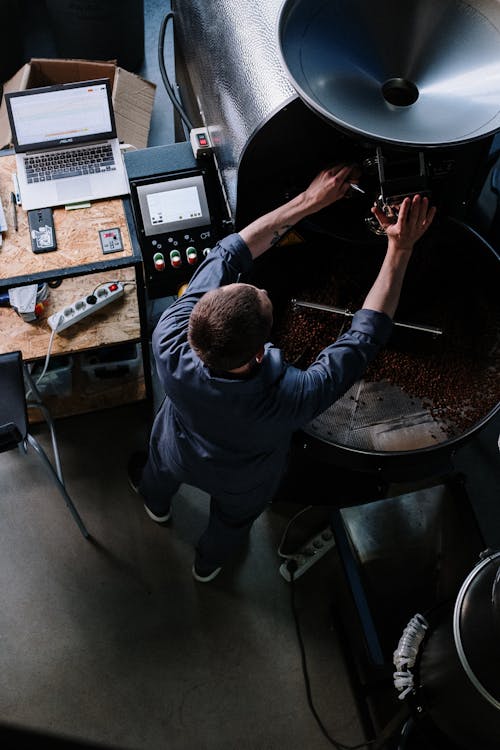
The drum is where green coffee beans transform into roasted ones. It's a rotating metal cylinder (typically stainless steel or carbon steel on commercial machines, stainless on most home units) that tumbles the bean mass over a heat source. The rotation matters: a stopped drum means beans sitting on the hot metal, scorching in under 30 seconds at full roasting temperature.

On drum roasters, heat transfers from the drum wall directly to bean contact surfaces (conduction) and from hot air inside the drum (convection). The ratio between those two modes shifts with drum speed, fill level, and airflow. That's exactly why changing batch size without adjusting your profile will produce a different roast.
Burner
The burner is the heat source. On gas-fired commercial and prosumer machines (the Probat P12, the Loring Kestrel, most Diedrich models), it's a natural gas or propane atmospheric burner sitting below or around the drum. On electric home roasters like the Fresh Roast SR800 or Sandbox Smart R1, heating elements or quartz infrared tubes serve the same function.
The burner's output (measured in BTU/hr on gas machines or wattage on electric) sets the ceiling on how fast you can raise bean temperature. You can always slow a roast down by reducing burner output. You can't speed it up past what the burner can deliver. This is why underpowered home roasters struggle with light-roast profiles that call for extended Maillard development: they can't hold a steady rate of rise at lower temperatures.
Agitator
Inside the drum, fixed paddles or fins (sometimes called agitators or flights) lift the beans and drop them as the drum rotates. They're what keeps beans tumbling rather than riding the drum wall. Without them, beans clump, develop unevenly, and you'll see a two-tone roast: light on the outside of the mass, dark on the drum contact side.
On smaller home roasters, the agitator is often just the drum geometry itself, a spiraled inner surface that moves beans forward toward the discharge gate. On commercial machines like the Probat, separate adjustable flights let you tune the bean cascade pattern per batch size.
Drum motor
The drum motor drives rotation. Standard drum speed runs 40 to 60 RPM on most prosumer and commercial machines, though some allow variable-speed control. Slower rotation (closer to 16 RPM, as seen on the Behmor 1600's slow mode) extends conductive contact time between beans and drum wall. That's useful for some natural-processed beans, but it increases the risk of tipping (scorching on the drum surface) in dark roasts.
How do roasters control temperature and timing?
Three components handle precision: the gas control valve, the temperature probe, and the control panel. These are what separate a repeatable, logged roast from a guess.
Gas control valve
The gas control valve modulates gas flow from the supply line to the burner. Turn it down and the burner output drops; turn it up and heat rises. On modern machines, this is actuated electronically and controlled through the panel. On older or simpler machines, it's a manual knob. Either way, it's the primary lever for adjusting your rate of rise during the roasting process.
The valve also has a hard safety function: full shutoff on loss of flame or gas pressure anomaly. If your roaster has a solenoid valve, learn where the manual override is before you need it.
Temperature probe
The temperature probe (almost always a K-type thermocouple on prosumer and commercial machines) measures the temperature at a specific point inside the roasting chamber. Most machines have at least two probes: one for bean temperature (BT), mounted so the tip contacts or nearly contacts the bean mass, and one for environmental temperature (ET), measuring the hot air inside the drum.
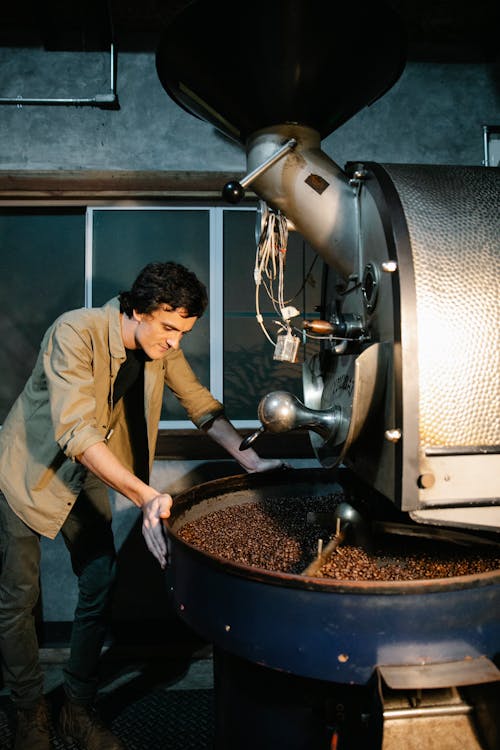
The gap between BT and ET is your rate of rise signal. If ET is rising faster than BT, you still have heat to absorb. If BT is catching up to ET, you're approaching a stall or a crash in the roast curve. Experienced roasters watch that gap, not just BT in isolation. Thermocouple calibration drift is real: after 100 or more batches, coating from roasting oils can offset readings by 5 to 8 degrees F, which is why cleaning the probe tip is part of standard maintenance on any serious machine.
Control panel
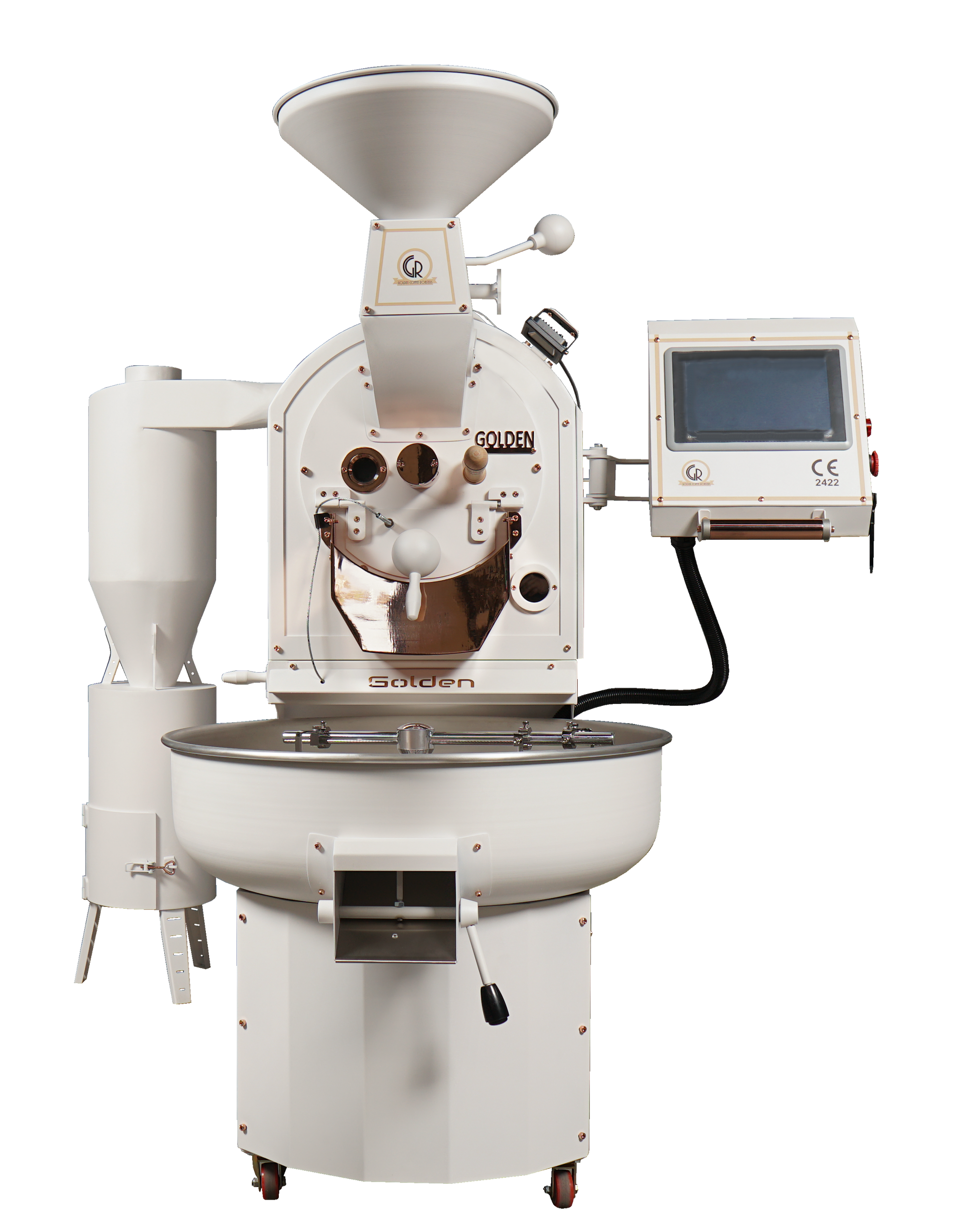
The control panel is where you see everything and adjust everything. On basic machines, that's a dial for heat and a timer. On modern prosumer roasters (the Aillio Bullet R1, the Sandbox Smart R1 with its app interface, Cropster-connected commercial machines), it's a real-time graph of BT and ET, a logged RoR curve, and a full profile library. The Golden Roasters GR5, pictured above, shows what a mid-range commercial control surface looks like: digital temperature readout, airflow controls, and manual/auto mode.
What the control panel can't do is compensate for bad physical setup. If your probe is coated in oils or your chaff collector is half-full, the numbers will lie. The panel reads what the sensors give it.
How do the exhaust system and chaff collector work?
These two components are often underappreciated until something goes wrong. Skipping maintenance on either one is how roaster fires start.
Exhaust system

The exhaust system pulls hot air, smoke, and chaff out of the drum and vents it externally. On commercial machines, this connects to an afterburner (catalytic or thermal) that incinerates smoke before it hits the outside air, a legal requirement in most municipalities with roasting operations above 1 lb/batch. On home roasters, it's typically a fan assembly that pushes exhaust to a window or vent hood.
Airflow rate affects your roast directly, not just your air quality. Higher airflow accelerates convective heat transfer into the bean mass and removes chaff faster. Lower airflow slows development and can let chaff back-accumulate in the drum. The Sandbox Smart F2 filter unit (pictured) is a purpose-built exhaust filter for home-roaster setups that want to manage indoor smoke without running a full duct to the exterior.
Chaff collector
As beans roast, they shed their silverskin, a thin papery membrane that separates from the bean during first crack and beyond. This is chaff. The chaff collector captures it before it circulates back through the machine or vents into your workspace.
Don't let chaff build up. Chaff is combustible at roasting temperatures, and accumulated chaff in a hot exhaust path is a documented cause of roaster fires in commercial operations. Most home roasters need the chaff collector emptied every 3 to 5 batches for dry-processed (natural) beans, which shed significantly more than washed coffees. Check it before every session, not after.
How do beans get in and out of the roaster?
Three parts handle the before and after: the bean hopper holds your charge, the bean loader transfers it into the drum, and the cooling tray stops the roast after discharge.
Bean hopper
The bean hopper sits above or beside the roaster and holds your unroasted charge before it drops into the drum. On home roasters, this is often just a small funnel or scoop station where you manually weigh and load. On commercial machines running continuous batches, the hopper holds 5 to 20 kg of greens and feeds the loader automatically, eliminating downtime between charges.
Hopper volume matters less than charge consistency. Whether you're loading 100 g into a Sandbox R1 or 5 kg into a Probat, you want the same weight every time. Charge size affects how the bean mass absorbs initial heat. A lighter charge heats faster and can tip if you don't adjust your first-minute burner settings.
Bean loader
The bean loader transfers greens from the hopper into the drum at the start of the roast cycle. On smaller machines this is a drop gate you open manually; on commercial machines it's an automated pneumatic or motor-driven feed that opens on a timer or at a target drum temperature.
Charge temperature matters. Most experienced roasters drop beans into the drum at a specific environmental temperature (anywhere from 375 to 425 degrees F depending on the machine and origin) because the charge temperature determines how the bean mass absorbs heat in the first critical two minutes. Inconsistent charge timing produces inconsistent drying-phase behavior, which compounds all the way through to first crack.
Cooling tray
After discharge, beans carry significant residual heat. They will keep roasting on that heat for 60 to 90 seconds if you don't cool them fast. The cooling tray is a perforated, flat surface (usually stainless) with a fan drawing ambient air up through the bean mass. On commercial roasters, a rotating arm stirs the beans while they cool to maximize surface exposure.
A slow cooling tray is one of the most common hidden causes of over-development in home roasting. If you pull beans at City+ and let them sit in a warm bowl for two minutes, you're getting Full City whether you wanted it or not. The Sandbox Smart C1 cooling tray is the dedicated solution for home roasters who don't want to chase beans around a colander in front of a box fan. It's purpose-built for the R1 and R2 and drops bean temperature below 100 degrees F in under four minutes.
Every part of a coffee roaster exists to give you control over one specific variable. Once you know what each component does, a bad batch stops being a mystery and becomes a diagnostic question: was it the probe reading low? Was the chaff collector restricting airflow? Did the charge drop too early? The machine tells you, if you know what to listen for.
Frequently Asked Questions
What is the most important part of a coffee roaster?
The drum and the temperature probe together. The drum is where the actual transformation happens. Without consistent rotation and heat transfer, no other component matters. The temperature probe (a K-type thermocouple on most prosumer and commercial machines) is what gives you the data to make real-time decisions. A roaster with a bad probe is flying blind, even with a perfect drum.
What is the difference between bean temperature and environmental temperature probes?
Bean temperature (BT) measures the temperature of the bean mass itself; the probe tip is positioned to contact or nearly contact the beans. Environmental temperature (ET) measures the hot air inside the drum. The gap between the two tells you how much heat energy the beans are still absorbing. When BT approaches ET, the rate of rise is flattening, a signal that you're near a stall or that first crack is close.
Why does chaff build up matter for fire safety?
Chaff is the silverskin that sheds from beans during roasting, particularly after first crack. It's lightweight, dry, and combustible at roasting temperatures. If it accumulates in the exhaust path or chaff collector near a hot burner or motor, it can ignite. Commercial roasting operations treat chaff collector emptying as a mandatory safety step before every session. Home roasters should do the same, especially when roasting dry-processed (natural) coffees, which produce significantly more chaff than washed beans.
What is rate of rise, and which part of the roaster controls it?
Rate of rise (RoR) is the speed at which bean temperature increases, measured in degrees per minute. It's controlled primarily by the burner (via the gas control valve on gas machines, or the power setting on electric machines) and the airflow through the exhaust system. The temperature probe and control panel display it in real time on machines equipped for logging. A declining RoR heading into first crack typically produces a cleaner, more even development; a crashing RoR can signal a stalled roast.
Do all coffee roasters have the same parts?
The 11 core components described here apply to drum roasters, which are the dominant type for home and commercial use. Air roasters (fluid-bed machines like the Fresh Roast SR800) replace the drum and agitator with a heated air column that both heats and suspends the beans. They don't have a drum motor or agitator, but they still have a burner or heating element, a temperature probe, a control panel, a chaff collector, and a cooling stage. The functions are the same; the mechanisms differ.
How often should I clean the temperature probe?
On a home roaster, clean the probe tip every 20 to 30 batches using a mild solvent. Isopropyl alcohol works fine. Roasting oils build up on the thermocouple tip over time and create a thermal insulation layer that causes the probe to read low. A 5 to 8 degree F offset sounds small, but it compounds across your entire roast curve. Most roasting software lets you apply a calibration offset, but cleaning is more reliable than compensating electronically for a dirty probe.
What happens if the cooling tray is too slow?
Beans continue roasting on residual heat for 60 to 90 seconds after they leave the drum. A slow cooling tray means you're losing control of your roast at the finish. Beans you intended to pull at City+ end up at Full City or beyond. In a professional context, the cooling target is below 100 degrees F within four minutes of discharge. If your home roaster's built-in cooling is underpowered for your batch size, a dedicated cooling tray like the Sandbox Smart C1, or even a colander in front of a box fan, is better than letting hot beans sit.
What is an afterburner on a coffee roaster, and do home roasters need one?
An afterburner incinerates smoke and volatile organic compounds from the exhaust before they vent externally. Commercial roasters above about 1 lb/batch are required by most air quality regulations (EPA rules at federal level; stricter in California, the Bay Area in particular) to use a thermal or catalytic afterburner. Home roasters operating at 100 to 500 g batches are generally below the threshold for regulatory requirements, but smoke management is still real: a kitchen without a range hood or window exhaust will fill with smoke on any roast past City. The Sandbox Smart F2 filter is designed specifically for indoor home-roaster setups that need smoke suppression at small batch scales.
Key takeaways:
- A drum coffee roaster has 11 core parts: drum, agitator, burner, gas control valve, drum motor, temperature probe, exhaust system, chaff collector, bean hopper, bean loader, and cooling tray.
- The temperature probe (K-type thermocouple) and control panel are your diagnostic instruments. Clean the probe every 20 to 30 batches or your readings will drift low.
- Chaff is combustible. Empty the chaff collector before every session, especially with natural-processed beans that produce more silverskin.
- The cooling tray stops the roast. A slow cool means over-development, because beans roast on residual heat for 60 to 90 seconds after drum discharge.
- Air roasters replace the drum and agitator with a heated air column, but still share the same core functions: heat generation, temperature sensing, airflow management, and rapid cooling.


Leave a comment