



Quick answer: The Baratza Encore ESP retails under $200 and runs 40mm Etzinger M2 conical burrs with a dual-resolution grind collar: steps 1 to 20 move burrs 20 microns per click for espresso dialing, steps 21 to 40 shift 90 microns for filter. It also includes an anti-static 0.85 oz dosing cup that fits 54mm and 58mm portafilters. For a first espresso grinder under $200, it's the strongest option in that price bracket.
The original Baratza Encore has been the default "first grinder" recommendation for about a decade, and for good reason: cheap, repairable, wide grind range. Its one real weakness was espresso. The M3 burrs it shipped with worked fine for filter but produced too many fines at espresso settings, and the 90-micron step increments made dialing in a shot more guesswork than precision. The Encore ESP fixes both of those problems without raising the price much.
Who makes the Encore ESP?
Baratza is a US-based grinder company that has been in the specialty coffee market since the late 1990s. They built their reputation on two things most budget grinder brands skip: consistent burr geometry and actual repair support. If you crack a burr housing, Baratza will sell you the part. That matters when you're looking at a $200 purchase that you expect to last five-plus years.
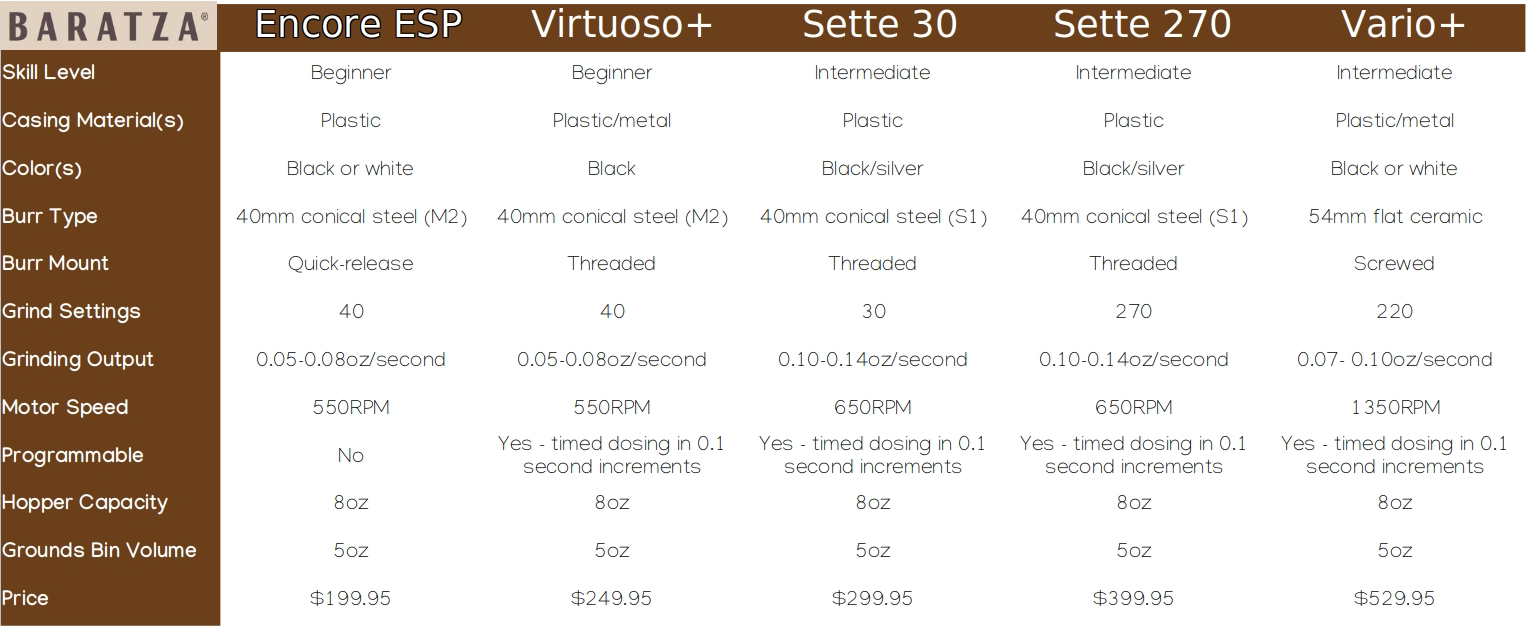
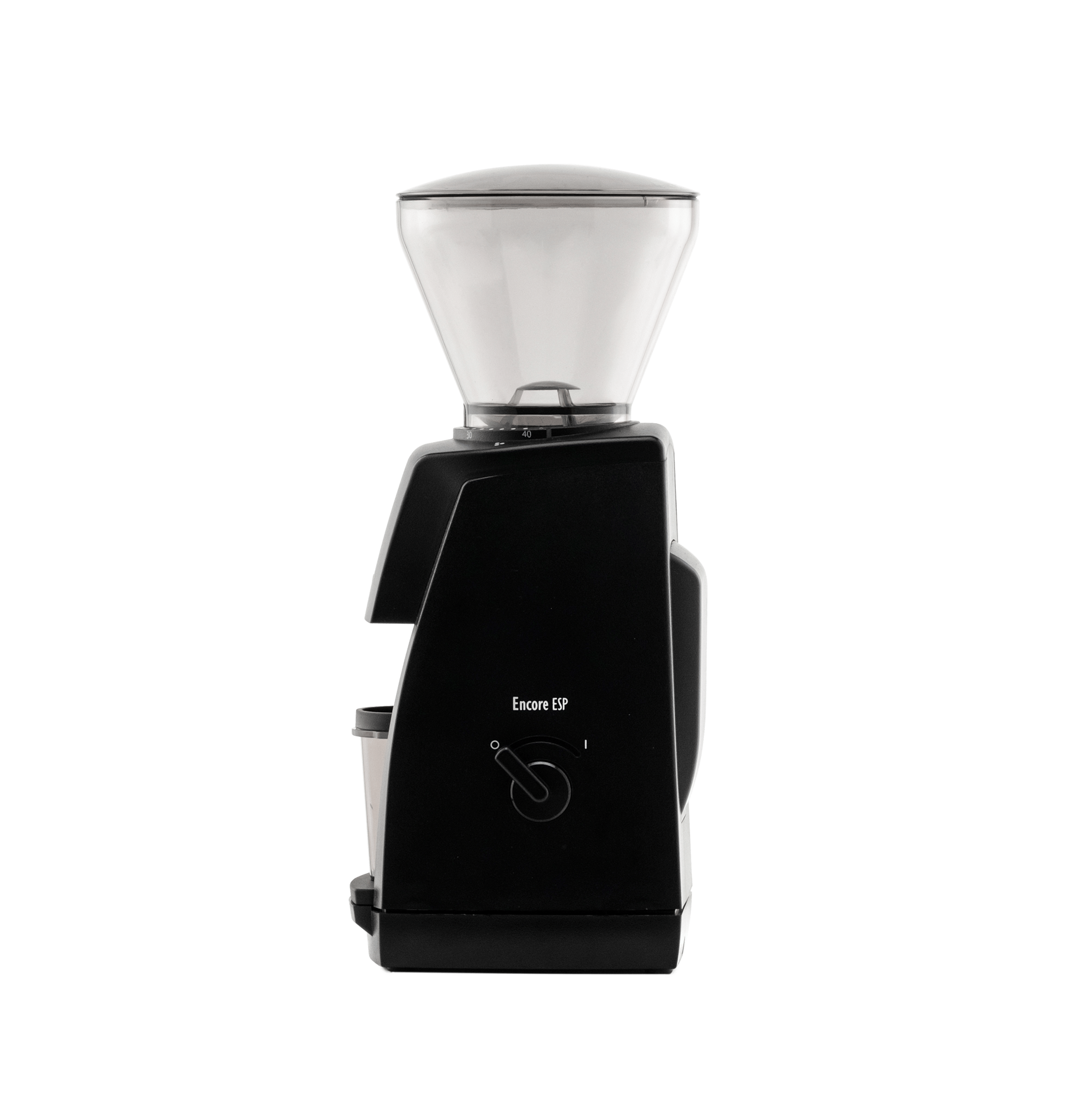
Their lineup runs from the entry-level Encore up through the Virtuoso+ and into the flat-burr Forte territory. The Encore ESP slots at the base of that stack but with a specific mission: make espresso accessible at a price where most alternatives either can't hit the required grind fineness or can't maintain it consistently across a bag.
What changed from the original Encore?
Design and build
The ESP looks a lot like the original Encore at a glance. Slimmer body, cleaner branding, same general footprint. The cast-metal base is the most important structural change: it keeps the grinder planted during the pulse bursts you'll be doing a lot of for espresso single-dosing. Still primarily plastic above the base, which is reasonable at this price. All existing Encore accessories fit the ESP housing.
Controls are the same two-option setup: a side lever for continuous grinding, a front pulse button for on-demand doses. Nothing revolutionary, but intuitive enough that you don't need the manual after the first session.
M2 burrs: the part that actually matters
The Encore used M3 burrs. The ESP uses M2s, also 40mm Etzinger hardened alloy steel, but with a sharper cutting angle. In practice this means fewer fines at espresso grind settings. Fines are what cause channeling in an espresso puck: they fill gaps between coarser particles and create inconsistent water paths through the coffee bed. Fewer fines means more even extraction. That's the direct line from the burr upgrade to the cup.
Same DC motor as the original. Low RPM keeps heat down, which matters for preserving volatile aromatics in light roasts. Baratza added thermal cutoff protection on the ESP, so if you're grinding back-to-back doses for a busy weekend brunch, the motor shuts down safely rather than stalling mid-batch.
Quick-release conical burr
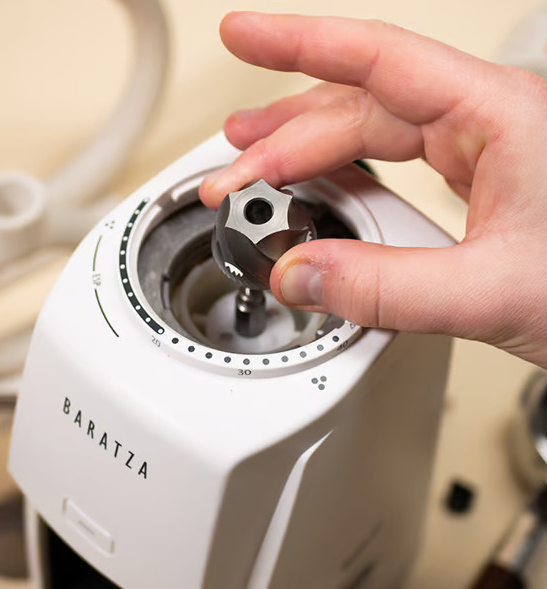
The original Encore required some effort to remove the cone burr for cleaning. The ESP gets a quick-release knob on the cone burr: twist, lift, done. The ring burr unlocks just as easily. Combined with the detachable hopper and a more open burr housing, cleaning now takes a couple of minutes rather than a minor battle. Baratza includes a cleaning brush in the box.
Dual-resolution grind adjustment
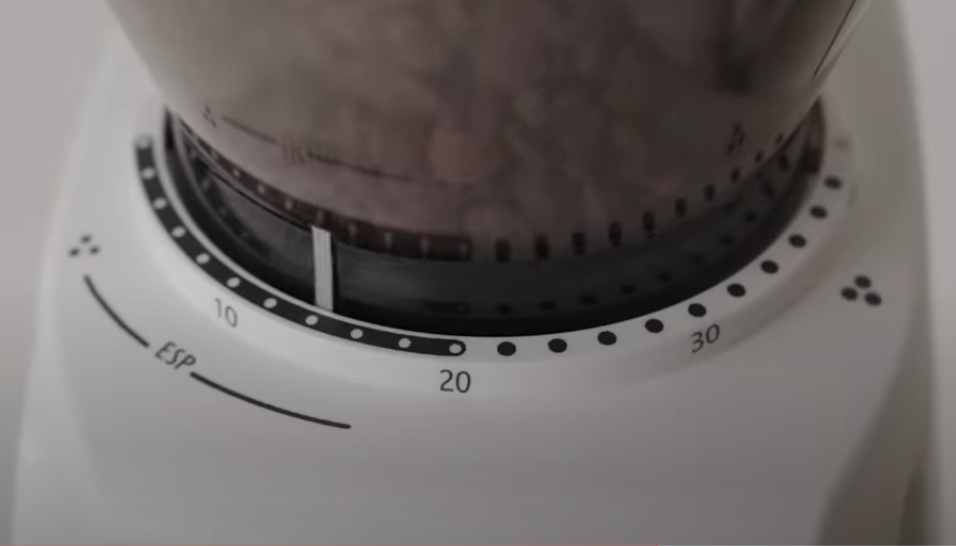
This is the engineering decision that defines the ESP. Both the Encore and the ESP have 40 stepped settings on the grind collar, now all-metal on the ESP. But Baratza split those 40 steps into two zones with different step sizes.
Settings 1 through 20 are espresso territory: each click moves the burrs 20 microns. Settings 21 through 40 cover filter methods at 90 microns per click. The finer steps in the espresso zone give you the adjustment resolution you need to actually dial in a shot. On the original Encore, a single click could mean the difference between a 20-second and a 35-second shot with no intermediate option. The ESP narrows that gap significantly.
The trade-off is worth knowing: the coarser zone's 90-micron steps are wider than the original Encore's macro steps, so you lose a small amount of precision at French press settings. If you're a dedicated filter-only drinker, the original Encore is still the better tool. For anyone who wants both espresso and filter from one grinder, the ESP makes the right call.
Espresso dosing cup
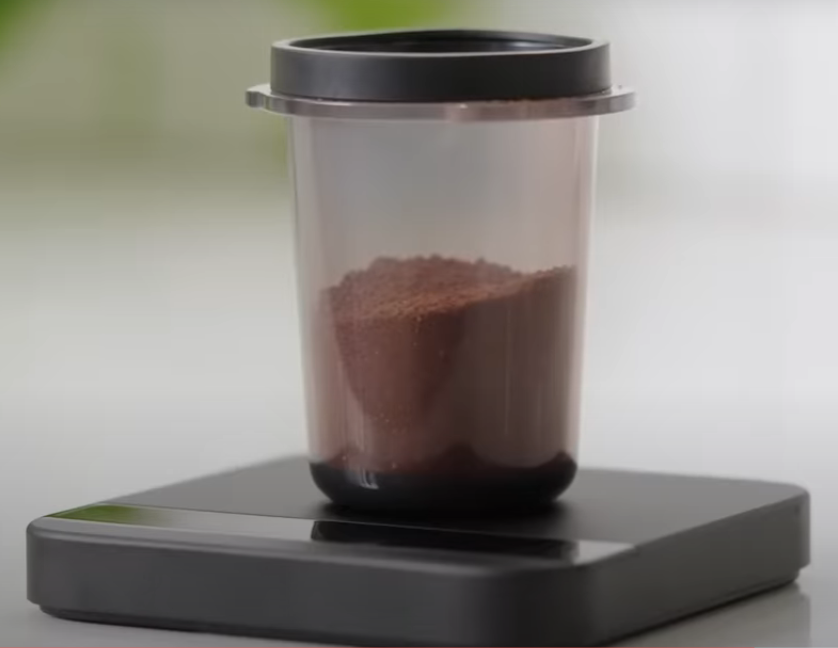
The ESP ships with a 0.85 oz anti-static dosing cup that sits in a stand under the grinder chute. Grind directly into the cup, then transfer to your portafilter. It fits 54mm portafilters out of the box; a supplied adapter ring extends compatibility to 58mm baskets. The anti-static design means the grounds don't cling to the cup walls, which reduces mess and makes distribution into the portafilter cleaner.
When you switch to filter brewing, swap the cup and stand for the grounds catch bin that also ships in the box. Same anti-static properties.
How does it compare to other grinders?
At the sub-$200 price point, the ESP's main competition is the Breville Smart Grinder Pro and the older Baratza Encore itself. The Smart Grinder Pro has 60 settings and a digital display, but its conical burrs are a smaller 40mm steel set that produce a wider particle distribution at espresso fineness. If fine-tuning a specific Ethiopian pour-over is your primary use, the Smart Grinder Pro's broader setting range is useful. For espresso, the ESP's 20-micron increments in the fine zone give you more controllable steps within the window that matters.
Step up to the Virtuoso+ at around $250 and you get 40 grind settings, a digital timer for dose consistency, and a slightly larger burr set with better grind uniformity across the full range. If espresso is your primary focus and you have $250 to spend, the Virtuoso+ is worth the step. If $200 is the ceiling, the ESP earns its place.
Grinding tips and starting settings
Run the ESP through two or three dummy grinds with cheap beans before you start dialing in your good coffee. New burrs have minor surface irregularities that normalize over the first few hundred grams. The grind quality improves noticeably after break-in.
Starting settings to work from:
- French press / cold brew: 31
- Chemex (pour-over): 30
- Automatic drip brewer: 28
- Hario V60 (pour-over): 25
- AeroPress: 22
- Espresso, medium roast, 17g dose: 15 (adjust higher for darker roasts or larger doses, lower for lighter roasts or smaller doses)
The included shims give you an additional layer of calibration beyond the collar steps. Each shim inserted or removed shifts the grind range by roughly five settings. Add shims for finer output, remove for coarser. This is useful if you find your espresso sweet spot sits between two collar clicks.
If you switch between brew methods regularly, single-dose rather than keeping the hopper full. The optional Single Dose Hopper (black or white, sold separately) holds up to 2.12 oz and includes integrated bellows to purge retained grounds between doses. Grind retention is modest on the ESP, but for espresso dialing, any retained stale grounds are a variable you don't want.
One more thing worth knowing: the ESP grinds can clump, especially at fine settings with lower-density naturals. A WDT (Weiss Distribution Technique) tool fixes this before you tamp. Running the grounds through a dosing cup first, then WDT-stirring, gives you a consistently even puck. The anti-static cup reduces clumping somewhat, but WDT is still worth doing if you're pulling shots for a machine with a pressurized basket where puck consistency makes a real difference.
Is the Encore ESP worth buying?
If you want to pull espresso at home without spending $400 on a grinder, the ESP is the right call at this price. The 20-micron steps in the espresso zone, M2 burrs, and anti-static dosing cup are three real improvements over the original Encore for espresso use specifically. You're not getting the flat-burr uniformity of a Niche Zero or the stepped-timer precision of a higher-end grinder. But you don't need those things at this price bracket.
The coarser filter zone's wider steps are the one genuine trade-off. If you mostly drink filter and only occasionally pull espresso, the original Encore might still suit you better. For anyone who wants to do both and does espresso more than twice a week, the ESP earns its keep.
Pair it with a capable espresso machine and browse the rest of the Baratza lineup if you want to see where you'd upgrade next. The grind like a pro guide covers technique for dialing in with any Baratza model.
Frequently Asked Questions
Can the Baratza Encore ESP actually grind fine enough for espresso?
Yes. The ESP's M2 burrs and 20-micron grind steps in settings 1 through 20 give it the range and adjustment resolution to reach true espresso fineness. Starting point for medium roast espresso is around setting 15. You'll dial from there based on your machine, dose, and roast level. It won't match a dedicated espresso grinder at $400 or above, but within its price class it performs well.
What's the difference between the Baratza Encore and the Encore ESP?
Three main changes: the ESP uses M2 burrs instead of M3 (sharper, fewer fines at espresso settings), a dual-resolution grind collar (20 microns per click in the espresso zone, 90 microns in the filter zone), and an anti-static dosing cup for portafilter compatibility. The ESP also adds a quick-release knob on the cone burr and thermal cutoff protection. The housing and motor are essentially the same.
Does the Encore ESP work with 58mm portafilters?
Yes. The included dosing cup fits 54mm portafilters natively. A supplied adapter ring extends compatibility to 58mm baskets, which covers most home espresso machines including the popular 58mm standard used by Breville, DeLonghi La Specialista, and similar machines.
Is there grind retention in the Encore ESP?
Some, yes. It's modest compared to grinders with longer chute paths, but there will be a small amount of retained grounds from the previous grind. For espresso, this matters because day-old grounds mixed into a fresh dose affect extraction. Single-dosing with the optional Single Dose Hopper and purging a gram or two before your dose solves this. The anti-static dosing cup helps with what does come out.
How loud is the Baratza Encore ESP compared to the original Encore?
Measurably quieter, according to Baratza's own testing, though the original Encore was never particularly loud. At espresso fineness the motor is working harder and grind time is longer per dose, so you'll hear it longer. In a typical kitchen it's not disruptive. If you live in an apartment with shared walls, it's fine for daytime use but noticeable in early morning.
Should I buy the Encore ESP or wait for a better grinder to come down in price?
If your budget ceiling is $200, buy the ESP. If you can stretch to $250 to $300, look at the Baratza Virtuoso+ or the Eureka Mignon Silenzio, both of which offer better grind uniformity across the full range. The "wait for a deal" strategy works better for flat-burr grinders where the price drop is more dramatic. The ESP's pricing has been stable since launch.
Can I use the Encore ESP for both espresso and filter brewing?
Yes, and that's its explicit design goal. The dual-resolution collar means you can dial in an espresso shot at setting 12 to 18 and then swing to a French press at setting 31 without losing either capability. The trade-off is that the coarser zone's 90-micron steps give you slightly less adjustment precision for filter than the original Encore. For most home filter brewing that's not a meaningful difference.
Key takeaways:
- The Encore ESP's M2 burrs reduce fines at espresso settings compared to the M3 burrs in the original Encore, which directly improves puck evenness and extraction consistency.
- The dual-resolution grind collar gives you 20-micron steps for espresso (settings 1 to 20) and 90-micron steps for filter (settings 21 to 40), so the adjustment resolution is where you actually need it.
- The included anti-static 0.85 oz dosing cup fits 54mm portafilters natively and 58mm with the supplied adapter; grind retention is modest but worth managing with single-dosing technique.
- The filter zone's wider steps are a real compromise: if you primarily drink filter coffee, the original Encore remains the better-optimized tool.
- At under $200, the Encore ESP is the strongest sub-$200 espresso-capable grinder option from a brand with genuine repair support and a large parts ecosystem.
Article reviewed by the CoffeeRoast Co. Editorial Team. Product specifications sourced from Baratza product documentation and cross-checked May 2026.


Virgil J
2月13,2024
I don’t really do espresso but I would like to grind for mocha pot is it better to have the ESP or the original but still with the M2 burr