



Quick answer: Set grind size before loading beans. Coarse works for French press, medium-fine for pour-over, fine for espresso. Add 15–20 g of whole beans, hold the body steady, and turn the crank clockwise until the grounds chamber fills. A medium grind with 20 g takes 60–90 seconds. Espresso-fine runs 2–3 minutes. Burr grinders produce a controlled, uniform particle size; blade grinders do not.
If you've cranked through a full dose and ended up with something that looks like half powder and half gravel, the grind setting was wrong for your brew method. That one adjustment changes everything downstream. Get it dialed before you load a single bean, and the rest is pretty straightforward.
What are the parts of a manual coffee grinder?
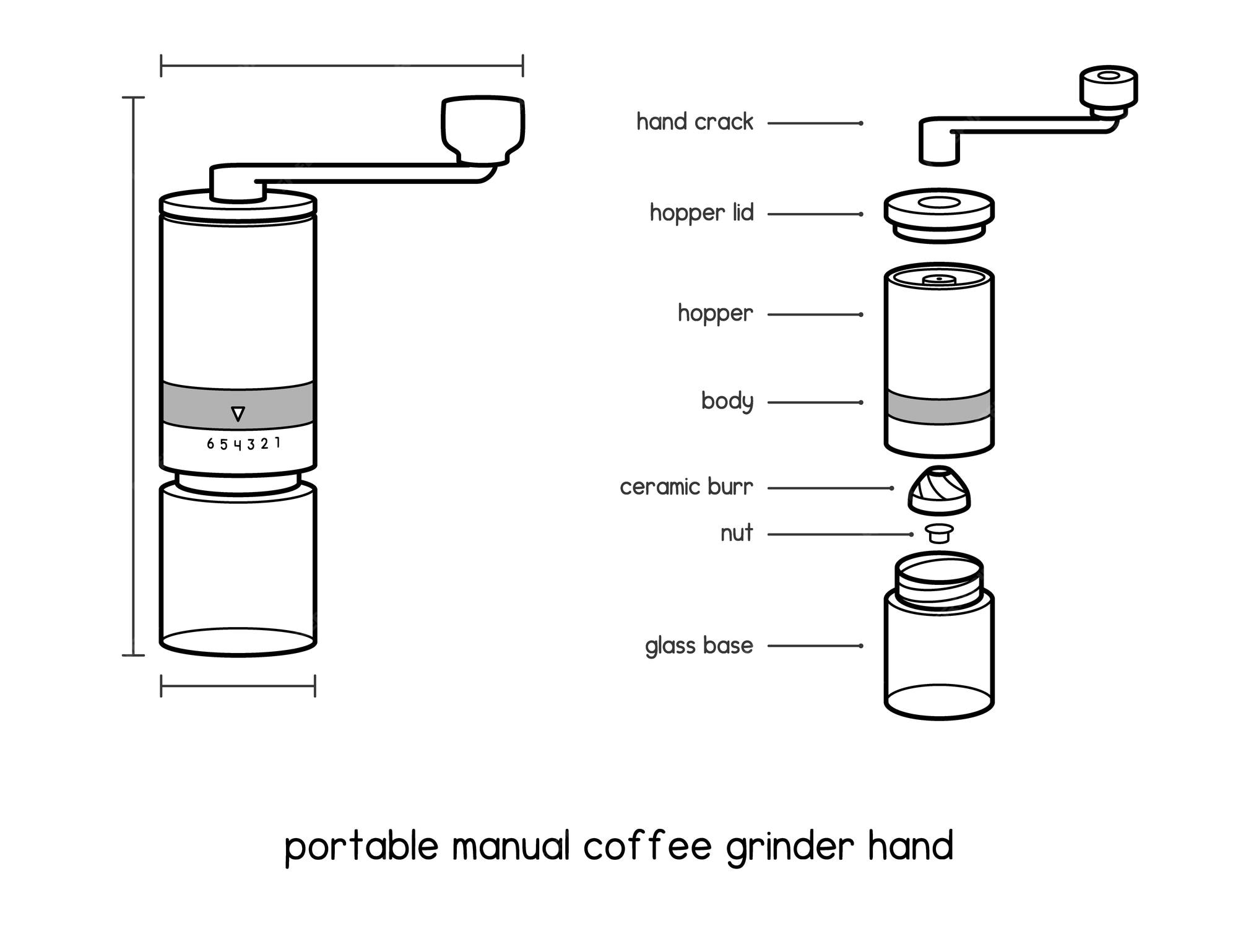
Every manual burr grinder shares four core components. Knowing what each one actually does is more useful than memorizing spec sheet numbers.

Burr mechanism

Two precision burrs — stainless steel or ceramic — sit facing each other with a fixed gap between them. Beans feed through that gap when you turn the handle and get crushed into particles. The gap size is what determines your grind size. That's the core reason burr grinders beat blade grinders: the gap is controlled and repeatable. A blade just chops randomly, leaving you with a mix of fine dust and coarse chunks that extract at completely different rates. You can't dial that in.
Adjustment dial

This knob or dial opens and closes the gap between the burrs. Clockwise tightens it for a finer grind; counterclockwise opens it up for coarser output. Most grinders have numbered click stops so you can return to a setting that worked. Write down the click count the first time you pull a shot you're happy with. You'll want that number again.

Handle and crank

The handle transfers your motion directly to the burr axle. A well-designed crank sits at a natural angle and doesn't flex under load. If yours wobbles mid-session, the most likely cause is a handle collar that isn't fully seated on the axle. Budget models have this problem more often than precision ones, and it's usually a 30-second fix: reseat the collar and snug it down before you start grinding.
Grounds chamber

The jar or drawer that catches finished grounds below the burrs. On most hand grinders it unscrews from the body, which makes pouring directly into a portafilter or French press much cleaner than scooping. Glass chambers let you see exactly how much you've ground without stopping to check — and that matters more than you'd think once you're mid-session.
How do you choose the right grind size?
Grind size controls how fast water moves through the coffee bed, and therefore how much flavor it picks up along the way. Too coarse and water rushes through before pulling any sweetness. Too fine and it stalls, dragging out bitter compounds. Here's the working map:
| Brewing method | Grind size | Visual reference | Why |
|---|---|---|---|
| French press | Coarse | Coarse sea salt | Long steep (4 min) needs slow extraction; fine grounds make it bitter and muddy |
| Cold brew | Coarse | Coarse sea salt | 12–24 hour steep; fine grounds over-extract and turn harsh |
| Aeropress | Medium to medium-fine | Table salt | Short brew time (1–3 min); adjust finer for shorter press, coarser for longer |
| Pour-over (V60, Chemex) | Medium-fine | Granulated sugar | Target 3–4 min total brew; too fine chokes the filter, too coarse runs fast and tastes flat |
| Espresso | Fine | Powdered sugar | 9 bar of pressure needs puck resistance from a tight grind to build proper extraction |
These are starting points, not locked targets. Taste the cup and adjust from there. Sour and thin means go one click finer. Harsh and bitter means open it one click coarser. Make one change at a time, or you'll lose track of what actually moved the needle.
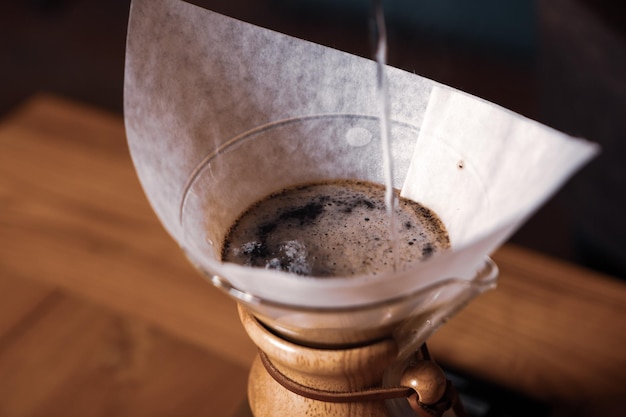
How do you use a manual coffee grinder, step by step?
Step 1: Set the grind size
Do this before beans go in. Adjusting the dial with a loaded hopper can jam the burrs or snap the setting mechanism on some grinders. Start at the coarsest end of the range and click inward until you reach the size your brew method needs. If you're not sure where to start, the middle of the dial works reasonably well for most pour-over and drip methods.
Step 2: Assemble the grinder
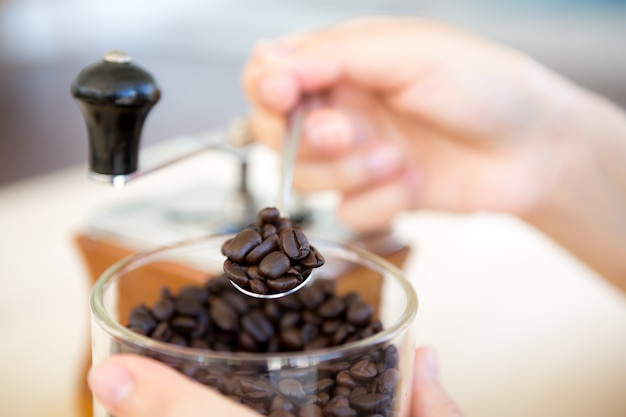
Seat the handle fully on the axle and screw the grounds chamber on until it's snug. Give the whole thing a quick shake. Any rattle or wobble means something's loose. Find it and tighten it before you load beans — a burr gap that shifts under load will give you an uneven grind no matter how carefully you set the dial.
Step 3: Add coffee beans
The Specialty Coffee Association's Golden Cup standard recommends 55 g of coffee per liter of water, which works out to 15 g of beans for a 240 ml cup and 30 g for a 480 ml brew. Don't load past the hopper's stated capacity. Overfilling stalls the burrs mid-grind and stresses the axle. Fresh beans also matter more than people expect: beans stored open for several weeks get harder and oilier, which makes the grind less consistent and the flavor noticeably flatter.
Step 4: Grind the coffee
Hold the body steady with your non-dominant hand and rotate the crank clockwise with your dominant hand. Steady and consistent beats fast. Pay attention to how it feels: smooth, firm resistance means the burrs are working cleanly. Gritty or stuttering resistance usually means debris in the burr set, or the setting is too fine for the bean density you're using.
For a medium grind with 20 g of beans, plan on 60–90 seconds of cranking. Espresso-fine takes longer — sometimes 3 full minutes — because the tight gap slows how fast beans feed through. That's not a mechanical problem. That's just the physics of fine grinding, and it's worth the wait to get the particle size right.
Step 5: Collect and brew immediately
Unscrew the grounds chamber slowly. Static electricity can throw a small cloud of fine grounds into the air if you move too fast — a lesson learned the hard way on a Tuesday morning in a white kitchen. Pour directly into your brewing device and brew right away. Ground coffee starts losing aromatics within minutes of leaving the burrs. The whole point of grinding fresh is freshness. Don't grind and walk away.
How do you clean and maintain a manual coffee grinder?
Coffee oils coat the burrs after every few sessions. Left to build up, they go rancid and leave a stale, bitter edge in cups made from even excellent fresh beans. Most home grinder users hit this wall around 3–4 weeks of daily use and can't figure out why their coffee tastes off. The burrs are usually the answer.
After each use, tap the body against your palm to knock loose grounds out of the burr set, then brush out the rest with a small stiff-bristled brush. Don't rinse burrs with water unless the manufacturer explicitly confirms they're waterproof. The axle bearings on many grinders will rust if water reaches them.
Every two to four weeks, do a deeper clean:
- Disassemble the grinder down to the individual burr discs.
- Brush the burr surfaces clean with a dry stiff brush.
- Wipe the grounds chamber with a dry cloth.
- Run a tablespoon of uncooked rice through the burrs at the coarsest setting to absorb residual oils, then discard the output. This works better than most commercial "grinder cleaning tablets" and costs effectively nothing.
- Reassemble and grind a small sacrificial dose of your actual beans before brewing, to clear any rice dust from the chamber.
Every few months, inspect the burr surfaces for chipping or visible dullness. Ceramic burrs are harder than stainless but chip more easily if a small stone sneaks in with the beans. A chipped burr produces uneven particles at every setting — no dial adjustment fixes that. Replace the burrs if you see damage.
What should you do if your manual grinder isn't working right?
Uneven grind size
Check that both burrs are seated and tightened correctly. Misalignment is the most common culprit. Also look at crank speed: turning too fast with a heavy bean load can let particles slip through before the burrs fully process them. Slow down before you start swapping settings.
Hard to crank or grinding feels stuck
The grind setting is probably too fine for the bean density you're using. Open the adjustment one or two clicks coarser and try again. If it's still fighting you, disassemble and check for a rogue bean fragment wedged between the burrs. It happens more often than you'd expect, especially with dense natural-processed beans.
Excessive wobbling
Tighten the handle collar where it meets the axle. If the wobble doesn't clear up, inspect the axle shaft for a bend. Bent axles almost always result from someone forcing a jammed grinder rather than stopping to clear the blockage first. Stop before you force it.
Inconsistent grind from session to session
Reset to the coarsest setting, click inward to your target, and write down the click count. If that number drifts between sessions on its own, the adjustment lock nut has come loose. Tighten it with the small hex key that most quality grinders include. The Kinu M47's stepless adjustment system is designed specifically around this problem: the magnetic click mechanism holds position reliably between sessions without needing a separate lock nut.
Recommended manual grinders from CoffeeRoast Co.
The CoffeeRoast Co. lineup covers most use cases with two grinders worth knowing. Here's the honest breakdown.
Kinu M47 Classic Manual Coffee Bean Grinder

German-made, 47mm Black Fusion-coated conical burr set. Dimensions: 25.5 cm x 19 cm x 12.5 cm. Weight: 1.85 kg. Batch capacity: up to 35 g. The stepless adjustment is what earns this grinder its price. Without fixed click stops, you can make micro-adjustments that genuinely move espresso extraction — a half-click change on this machine shifts shot time by 2–3 seconds, which matters when you're trying to hit a 27-second window. If you're dialing in espresso at home and you want settings that hold reliably between sessions, this is the right tool. It handles pour-over and filter beautifully too, though at 1.85 kg it's not something you'd carry on a plane.
The catch is the axle bearing is tight-tolerance by design. If you feel resistance while cranking, stop. Disassemble and clear whatever's blocking before you continue. Forcing a jammed Kinu can warp the bearing seat, and that's a repair that costs more than a budget grinder.
Sandbox Smart G1 Coffee Bean Grinder
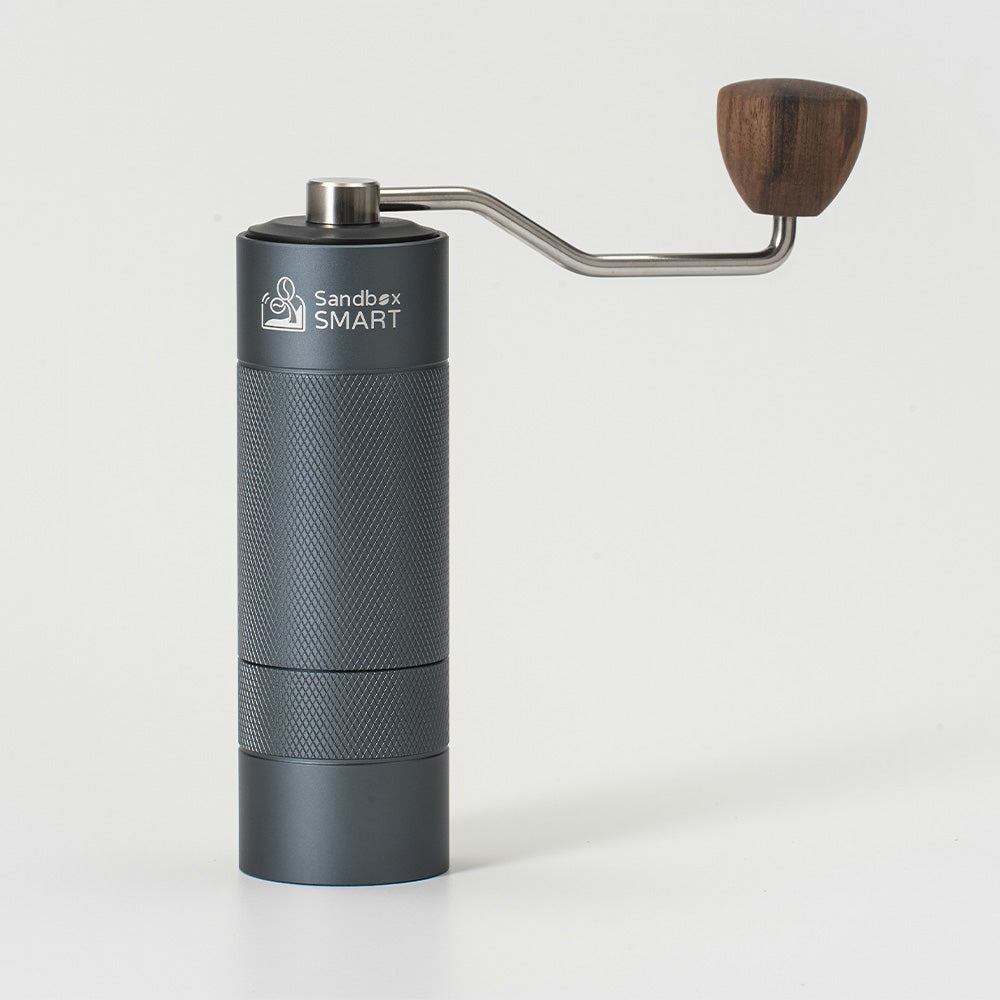
38mm stainless steel conical burr grinder with a natural wooden handle. Weight: 1.5 kg. Dimensions: 20.5 cm x 19 cm x 7 cm. Batch capacity: 35 g. It's lighter and more compact than the Kinu, which makes it a practical daily driver if you're also making coffee at someone else's place on weekends. The wooden handle won't suit every aesthetic, but it sits well in hand and doesn't conduct heat from a warm surface the way metal does. For pour-over, French press, and Aeropress it's consistent and easy to live with. It won't satisfy an espresso purist who needs sub-click adjustability, but for everything else in the lineup it does the job cleanly.
Frequently asked questions
How long does it take to grind coffee with a manual grinder?
For a coarse French press grind with 20 g of beans, expect 45–60 seconds. A medium pour-over grind takes 60–90 seconds for the same dose. Espresso-fine grinds run 2–3 minutes because the tight burr gap slows the feed rate. Burr diameter matters here: the 47mm burr set on the Kinu M47 moves more coffee per rotation than a 38mm set, so it's faster at equivalent grind sizes.
Is a manual coffee grinder better than an electric one?
At the same price point, manual grinders typically deliver better grind consistency than electric ones. They use larger, higher-tolerance burrs and don't have motor vibration shifting burr position under load. Electric wins on convenience and batch size — no argument there. But if you're grinding 20–30 g a day and care about what ends up in the cup, manual is the better value under $300. Above $300, electric flat-burr grinders like the Eureka Mignon Specialita start to close the quality gap in a meaningful way.
Can I use a manual grinder for espresso?
Yes, but the grinder needs stepless or near-stepless adjustment. Fixed click-stop grinders rarely land exactly where espresso requires because the gap between clicks is too wide for the precision espresso demands. The Kinu M47 is built for espresso-capable hand grinding. Cheaper click-stop grinders under $60 will get you in the neighborhood but not close enough for a consistently dialed shot.
Why does my hand-ground coffee taste bitter?
Bitterness usually means the grind is too fine, the water temperature is above 96 °C, or the brew time ran long. Start by opening the grind one click and re-brewing before touching anything else. If it's still bitter after that, check your brew time against the target for your method: 3–4 minutes for pour-over, 4 minutes for French press. One more variable worth checking: how old are the beans? Beans past 6 weeks off-roast can taste bitter regardless of grind setting.
How often should I clean my manual coffee grinder?
A quick brush-out after every use takes about 30 seconds and prevents oil buildup. A full disassembly clean every 2–4 weeks is plenty for daily use. If you're grinding oily dark-roast beans daily, move to weekly deep cleans — that oil coats the burrs faster and goes rancid sooner than most people expect. The rice-run method (one tablespoon at the coarsest setting, discard the output) absorbs residual oils effectively between full cleans.
What's the best coffee-to-water ratio for manual grinding?
The SCA Golden Cup standard recommends 55 g of coffee per liter of water for drip brewing, which works out to 1:16 to 1:18 by weight. For a standard 240 ml cup that's 15 g of beans. For a 360 ml travel mug, 20–22 g. French press is often brewed at 1:15, slightly stronger. These are baselines; taste your cup and adjust from there.
Should I grind coffee right before brewing?
Yes. Ground coffee starts oxidizing within minutes: volatile aromatics escape and CO2 degasses rapidly from the freshly exposed surfaces. Grinding immediately before brewing is the biggest quality advantage a hand grinder gives you over pre-ground. A 10-minute gap between grinding and brewing produces a measurably flatter cup at the same extraction parameters. Grind, then brew.
Key takeaways:
- Set grind size before loading beans: coarse for French press and cold brew, medium-fine for pour-over, fine for espresso.
- Burr grinders produce a controlled, uniform particle size that blade grinders can't match, which is why the cup tastes different.
- Use 15 g of beans per 240 ml of water (1:16 ratio) as your starting point, then adjust by taste.
- Grind immediately before brewing. Aromatics degrade within minutes of leaving the burrs.
- Brush the burrs after every use; full disassembly clean every 2–4 weeks prevents rancid oil from ruining fresh beans.
Article reviewed by the CoffeeRoast Co. Editorial Team. For a deeper look at espresso grinding specifically, see how to grind coffee beans for espresso.


Dejar un comentario