



Quick answer: The Kinu M47 is a German-engineered manual grinder with 47mm conical steel burrs, four ball bearings on a stainless axle, and a 50 g catch cup. It grinds reliably from Turkish fine to French press coarse. At its price point, it's the most mechanically consistent hand grinder CoffeeRoast Co. carries, but you're paying for precision, not speed.
Most grinder reviews tell you a hand grinder is "precise." Few of them explain what that actually means or where the design earns it. This one will. The M47 has been in production long enough to have a documented failure pattern and a clear user profile, and knowing both helps you decide whether it's the right tool for how you actually brew.
Who makes the Kinu M47?
Kinu is a German company focused on manual grinders for home and light commercial use. The M47 is their flagship model, developed and manufactured in Germany from stainless steel, aluminum, and brass, with no plastic in the burr assembly or catch cup.
The design prioritizes mechanical stability: four steel ball bearings on a stainless steel axle keep the burr centered under load. That's the thing that separates the M47 from most hand grinders in this category. It's not just about burr material; it's about keeping the upper and lower burr faces parallel as you grind. Wobble is where inconsistency comes from, and the bearing system is what Kinu built to fix it.
The catch cup holds up to 50 grams of ground coffee, which is enough for two full Aeropress batches or a single French press at a medium dose. The stainless steel cup (rather than ABS plastic) means grounds pour cleanly without static clinging to the sides.
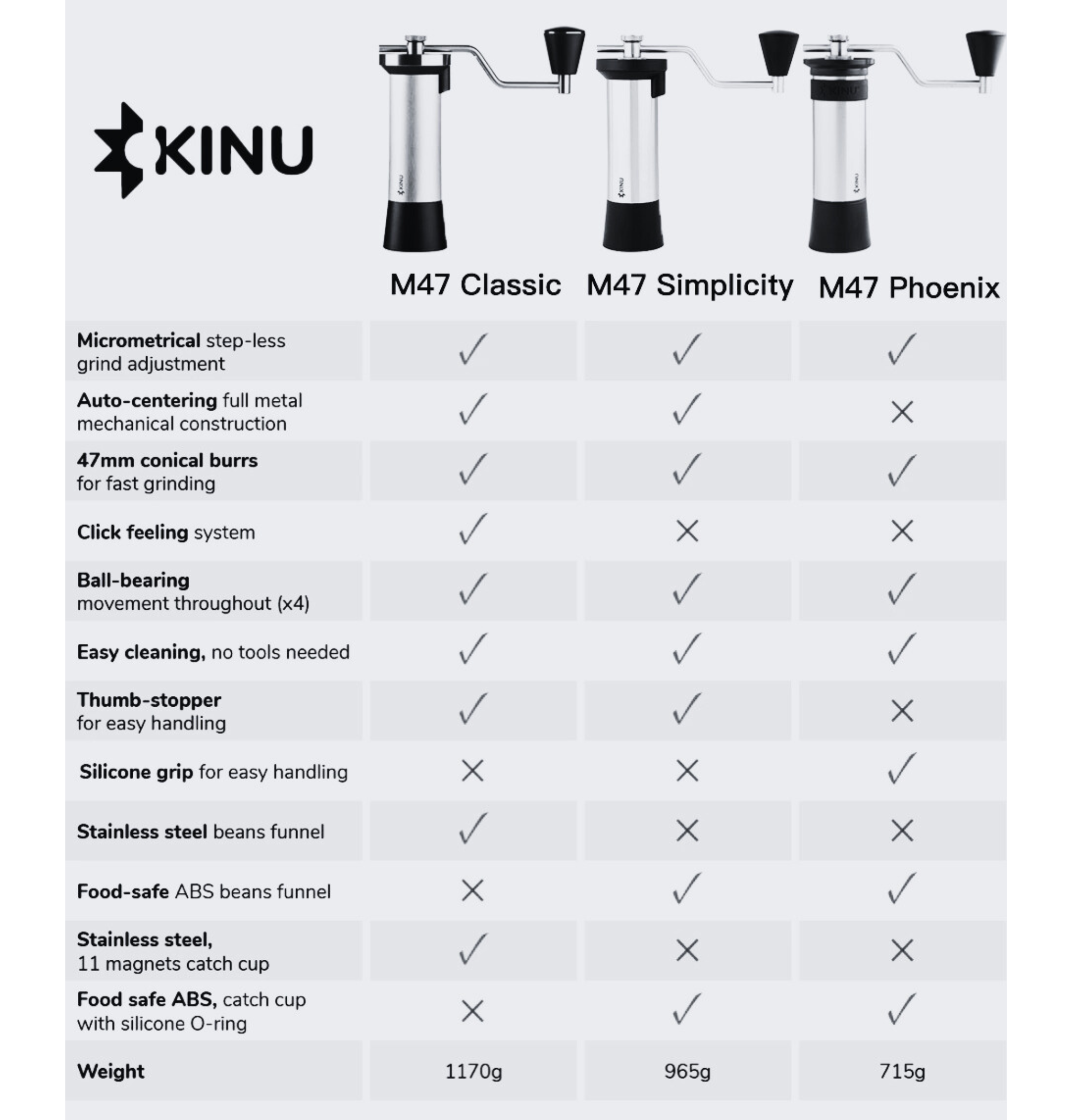
The Classic model uses an ABS plastic thumb stopper and crank handle; the Phoenix upgrades to a silicone grip. Worth knowing: if you're grinding every day in a humid kitchen, the silicone grip on the Phoenix holds up noticeably better over 18 months of use.

What are the three Kinu M47 models?
Kinu makes three versions of the M47. They share the same core mechanism but differ in burr size, adjustment style, and finish. Here's where each one earns its place.
Kinu M47 Classic

The Classic is the straightforward choice for most people. It runs 47mm conical steel burrs with a micrometric adjustment knob and a cylindrical body with a wooden knob. The grind range covers Turkish fine through coarse French press without losing consistency at either extreme, and the 47mm Black Fusion coated burrs do particularly well on espresso and fine drip, where other hand grinders at this price tier start to drift.
Failure mode to know: the wooden knob on the Classic is the first thing that shows wear. After a year or two of daily use, the finish dulls and the fit loosens slightly. It doesn't affect grinding performance, but it's a tell that you're looking at a cosmetic trade-off for the traditional aesthetic. If longevity of every component matters to you, step up to the Phoenix.
Kinu M47 Phoenix

The Phoenix is the top of the M47 line. It steps up to a 48mm burr set with a revised mounting mechanism and high-alloyed, high-nitrogen stainless steel burrs, a harder alloy than the Classic uses, which holds its edge longer under daily use. The angular body and hybrid step/stepless adjustment give it a different feel from the Classic's round cylinder.
It ships with a carrying bag and an authenticity certificate. That's not just marketing: the certificate documents the burr set's specific tolerances, which matters if you're the kind of person who wants to know what you bought. Baratza's Vario+ at a similar price point doesn't offer that level of documentation. The Phoenix is the right call if you're grinding for espresso daily and want the burr to stay consistent over two or three years without resharpening.
Kinu M47 Simplicity

The Simplicity uses the same 47mm conical steel burrs as the Classic but with a step-less adjustment mechanism and a metal knob instead of wood. Fewer parts, lower entry price, same burr quality. It's the M47 for someone who wants the grinding performance without the adjustment precision of the micrometric system.
Step-less means infinite adjustment, which sounds better than it is if you're dialing in espresso, because there's no click-stop to return to when you want to repeat a setting. For filter methods, pour-over, and French press, the Simplicity is excellent. For espresso where you're pulling shots and comparing back-to-back, the Classic's micrometric system is worth the price difference.
How do you use a Kinu M47 grinder?
The M47 doesn't require a learning curve, but a few habits make a real difference in consistency.
- Place the grinder on a flat, stable surface. Attach the crank handle to the top spindle.
- Turn the adjustment knob at the base. Turning clockwise makes the grind finer; counterclockwise makes it coarser. On the Classic, each click of the micrometric ring equals one precise step. Dial to your target setting before loading beans.
- Remove the hopper, add your beans (the catch cup holds up to 50 g of grounds, so dose accordingly), and reattach the hopper.
- Hold the body with your non-dominant hand and turn the crank with your dominant hand. The direct-drive mechanism gives you feedback through the handle: you'll feel coarser beans require less torque than fine-grind settings.
- Unscrew the catch cup and pour directly into your brewing vessel. The stainless steel surface minimizes static and clinging.
- Brush out the hopper and grind chamber after each session. For a thorough clean, the grinder disassembles fully. Do this every two to four weeks if you're grinding daily.
How do you get the most out of a Kinu grinder?
Start with beans roasted within the last two to four weeks. The M47's precision shows up most clearly with fresh coffee, since stale beans grind inconsistently at fine settings regardless of burr quality.

Turn the handle at a steady, moderate pace. Grinding too fast generates heat from friction at the burr faces, which affects volatile aromatics in the ground coffee. You're not trying to save time here: the M47's whole point is grind quality, and rushing the crank defeats it.

Use the M47 as your daily driver, not a special-occasion piece. The bearing system seats in better with regular use, and you'll develop a feel for the adjustment steps that makes dialing in faster over time. Storing it unused for weeks means re-learning your settings each time.
Clean the burrs with a dry brush every two to four weeks. Roasting oils coat the burr faces over time and shift grind consistency in ways that are easy to misattribute to bean quality or adjustment settings. A clean burr is a predictable burr.
How does the Kinu M47 compare to other hand grinders?
The honest comparison point is the 1Zpresso JX-Pro, a popular hand grinder at a lower price with a similar burr diameter. The JX-Pro runs 48mm stainless burrs with a stepped adjustment and delivers good filter-grind consistency. Where the Kinu M47 Classic pulls ahead is espresso: the micrometric adjustment on the Classic gives you finer steps between settings, which matters when you're chasing a 1:2 shot ratio and need to move the grind by less than one click-stop at a time. The JX-Pro's steps are coarser, and that shows up when you're dialing in.
The M47's build also lasts. Stainless steel, aluminum, and brass throughout the main body. Four steel ball bearings on the axle. The only plastic in the assembly is the Classic's thumb stopper and crank handle, and even that is a deliberate weight-reduction choice for portability, not a cost cut. Kinu's 47mm Black Fusion coated conical burrs handle Turkish, espresso, and fine drip well; at coarser settings for pour-over or French press, they're equally solid.
It's also small enough to fit in a daypack. If you travel with your grinder, the M47 holds up to the abuse of a carry-on bag in a way that cheaper hand grinders with plastic housings don't.
The catch: it's a hand grinder. If you're grinding for two or more people every morning, the 50 g capacity means two loads minimum, and 100 g by hand takes real time. For solo use or travel, that's fine. For a household of three coffee drinkers, consider whether a quality electric grinder like the Baratza Encore ESP is a better fit for your actual morning routine.
Frequently Asked Questions
What grind settings does the Kinu M47 cover?
The M47 covers the full range from Turkish fine through French press coarse. The Classic's micrometric adjustment makes it well-suited for espresso dialing, where step precision matters most. The Simplicity's step-less system covers filter methods cleanly but is harder to repeat for espresso. The Phoenix covers the same range as the Classic with a 48mm burr set that performs particularly well at espresso fine settings.
Is the Kinu M47 worth it for espresso?
Yes, with one caveat. The 47mm Black Fusion coated conical burrs on the Classic and Simplicity produce consistent espresso-fine grinds, and the micrometric adjustment on the Classic gives you the step precision espresso dialing requires. The caveat is time: grinding 18-20 g of espresso-fine coffee by hand takes 60-90 seconds with consistent effort. If you pull two or more shots a day, you'll feel that. For one shot in the morning, it's a non-issue.
How does the Kinu M47 compare to the 1Zpresso JX-Pro?
Both run similar burr diameters and deliver good filter-grind consistency. The M47 Classic has the edge for espresso: its micrometric adjustment allows finer steps between settings, which matters when you're chasing a precise extraction. The 1Zpresso JX-Pro is a strong value at its lower price point for filter-only brewing. If espresso is your primary method, the M47's adjustment precision is the deciding factor.
How often should I clean a Kinu M47?
Brush out the grind chamber after each session. Do a full disassembly and burr clean every two to four weeks with daily use. Roasting oils accumulate on the burr faces and shift grind consistency over time, which is the most common cause of "my grinder stopped performing like it used to" complaints on forums like Home-Barista. Regular cleaning keeps the M47 performing to spec.
What's the difference between the Kinu M47 Classic and Phoenix?
The Phoenix uses a 48mm high-alloyed, high-nitrogen stainless steel burr set (a harder alloy than the Classic's 47mm burrs) and a revised mounting mechanism for tighter tolerances. It ships with a carrying bag and authenticity certificate. The angular body and hybrid adjustment system also differ from the Classic's cylindrical micrometric design. The Phoenix is the right upgrade if you're grinding for espresso daily and want the burr to hold its edge longer over two to three years.
Can I use the Kinu M47 for travel?
Yes. The M47 is compact and light enough for carry-on bags. The stainless steel and aluminum construction handles the routine bumps of travel better than grinders with plastic housings. The 50 g catch cup is enough for two Aeropress batches or a single pour-over at a medium dose, which covers most travel brewing scenarios. The Phoenix's carrying bag makes it the better travel choice if aesthetics matter to you.
Key takeaways:
- The Kinu M47 runs 47mm conical steel burrs on a four-bearing stainless axle. The bearing system is what separates its grind consistency from cheaper hand grinders at similar price points.
- Three models to choose from: Classic with micrometric adjustment (best for espresso dialing), Simplicity with step-less adjustment (best for filter methods), and Phoenix with 48mm upgraded burrs and tighter tolerances (best for daily espresso long-term).
- The 50 g stainless catch cup holds enough for two Aeropress batches or one French press load; suitable for solo or travel use, less practical for multi-person households grinding daily.
- Clean the burrs every two to four weeks with daily use. Oil accumulation is the primary cause of consistency drift over time.
- For the full Kinu lineup, browse the Kinu collection at CoffeeRoast Co.


Leave a comment