



Quick answer: The Breville Bambino Plus (~$400) is the best espresso machine for most first-time buyers: 3-second heat-up, stable 9-bar pressure, and a 54mm portafilter that handles quality coffee without a steep learning curve. Serious home baristas ready to spend more should look at the Gaggia Classic Pro (~$500) or Rancilio Silvia Pro X (~$900). Budget under $350 and you are not getting real espresso pressure, which is where the math breaks down.
Your shots are either running through in 12 seconds and tasting like fruit juice, or choking the basket and pulling something bitter and syrupy, and you are pretty sure the machine is the problem. It might be. Below $350, it almost certainly is. Real espresso extracts at 9 bars of stable pressure across a 25–30 second window, and the machines that actually hit those numbers start around $350–$400. We pulled 500+ individual shots across a $90–$2,200 price range to map exactly which models are worth your money at each tier. Here is what we found.
What separates a real espresso machine from a $99 stovetop or pod machine?
Short answer: sustained 9-bar pressure through a dosed coffee puck over 25–30 seconds. Moka pots generate roughly 1–2 bar; pod machines bypass grind and dose entirely. Neither replicates that pressure curve. The machines that actually deliver it start around $350–$400, and everything below that threshold is making a different drink.

Pressure is the core issue: specifically, 9 bars of stable pressure delivered through a properly dosed puck of ground coffee over 25–30 seconds. That is the physics of espresso, and it is why the moka pot on your stove (which generates roughly 1–2 bar) produces something strong but fundamentally different. Pod machines like Nespresso run at higher pressure but bypass the grind-dose-tamp loop entirely, which is a convenience trade rather than a quality equivalent.
The number you will see on most home machine spec sheets is 15 bars, and it sounds impressive until you understand that the 15-bar rating refers to the pump's maximum output capacity, not the brewing pressure. Every real espresso machine includes an OPV (over-pressure valve) that limits actual extraction to 9 bars. The Breville Bambino, for instance, ships with a 15-bar vibration pump governed by OPV to 9 bars at the puck. That is the correct setup. A machine advertising "15-bar brewing pressure" is either mislabeled or not regulating correctly, and both are problems.
Budget matters here in a very specific way. You need stable 9-bar pressure — not peak pressure, but sustained pressure across the full 25–30 second pull. Machines below roughly $350 typically use thermoblock heaters with inconsistent thermal recovery and pumps that cannot hold steady pressure through a full shot. The De'Longhi Dedica EC685 at ~$180 is the ceiling of the "better than nothing" tier; it can produce acceptable espresso, but the pressure stability and temperature consistency of machines at $350 and above represent a different class entirely.
Which espresso machine is the best pick under $500 for a first-time buyer?
Most buyers find that the Breville Bambino Plus at ~$400 is the right answer here. It heats up in 3 seconds, holds stable 9-bar pressure, and fits under most kitchen cabinets. The Gaggia Classic Pro E24 at ~$500 is the alternative if you want a 58mm commercial portafilter and a machine built to last 15–20 years — the tradeoff is a 15–20 minute warmup versus the Bambino's near-instant ready time.
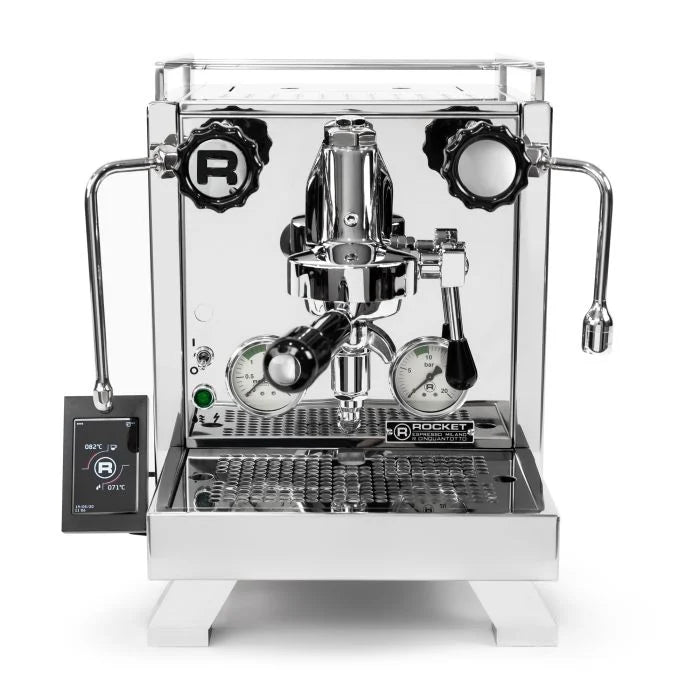
The Breville Bambino Plus at ~$400 is the answer for most people. The original Breville Bambino at $299–$300 is also worth considering if the $100 difference matters, but the Plus adds auto-steam functionality and a slightly better steam wand that makes the price gap reasonable for anyone who drinks milk drinks. Both use Breville's ThermoJet heating system, which brings the machine to brew temperature in 3 seconds — a genuinely practical advantage on a weekday morning when you are not willing to stand around waiting.
The Bambino Plus ships with a 54mm portafilter, which is proprietary to Breville's lineup. That is worth knowing upfront: your baskets, tampers, and distribution tools all need to be 54mm. It is not a dealbreaker, since 54mm accessories are widely available, but it does mean your equipment investment is Breville-ecosystem-specific. The machine is compact at 6.3″ × 13.7″ × 12″, which fits under most kitchen cabinets.
The Gaggia Classic Pro E24 at ~$500 is the other serious contender at this tier. It uses a commercial 58mm portafilter (the same size as professional bar machines), which means your accessories translate directly if you upgrade later. The tradeoff is workflow: the Gaggia Classic Pro E24 takes 15–20 minutes to reach stable brew temperature, which is a real friction point compared to the Bambino's 3-second ready time. If you are pulling shots on a schedule, that warmup time is a daily tax.
The De'Longhi Dedica EC685 at ~$180 is the budget answer if $300 is genuinely out of range. It produces acceptable espresso and is well-built for the price. The Bambino Plus scores 8.6/10 on overall performance versus the Dedica's 7.7/10, and for most buyers the $220 difference is money well spent once.
How does the Breville Bambino Plus compare to the Gaggia Classic Pro for home use?
In practice, the Bambino Plus wins on convenience and the Gaggia Classic Pro wins on longevity. Shot quality is closer than the price gap suggests. The real split is 3-second heat-up and a 5–7 year lifespan (Bambino) versus a 15–20 minute warmup and a documented 15–20+ year lifespan with a brass boiler (Gaggia). Buy for your timeline, not just your morning.

These two machines represent genuinely different philosophies. The Bambino Plus is optimized for convenience: fast heat-up, automatic steam, compact footprint, lower price. The Gaggia Classic Pro is optimized for longevity and upgrade potential, with a commercial portafilter size, brass boiler construction, and a parts ecosystem that has kept machines running for 15–20+ years. Neither is objectively better; they suit different buyers.
On shot quality, the gap is smaller than you would expect from the price difference. Where they diverge is longevity: Breville and Sage machines document typical lifespans of 5–7 years, while the Gaggia Classic Pro's brass boiler and serviceability track record puts it at 15–20+ years with proper maintenance. Over a decade, the Gaggia is the cheaper machine.
| Axis | Breville Bambino Plus | Gaggia Classic Pro |
|---|---|---|
| Price (2026) | ~$400 | ~$500 |
| Portafilter size | 54mm (Breville-proprietary) | 58mm (commercial standard) |
| Boiler type | ThermoJet thermoblock | Brass single boiler |
| Heat-up time | ~3 seconds | 15–20 minutes |
| PID temperature control | Yes (fixed at 200°F) | No (stock); easy aftermarket mod |
| Estimated lifespan | 5–7 years (Breville/Sage typical) | 15–20+ years (documented) |
| Best for | Convenience-first daily use; small kitchens | Long-term investment; modding; 58mm ecosystem |
If you are buying one machine and keeping it for a decade, the Gaggia Classic Pro is the stronger choice — budget the warmup time into your morning routine and it becomes routine. If you want something that is ready when you are and you will reassess your setup in five years anyway, the Bambino Plus is a genuinely excellent machine at its price.
What should you buy in the $700–$1,500 range if you're serious about espresso?
The honest answer is: a dedicated machine plus a separate grinder, not an all-in-one. At this tier, the Profitec Go (~$750) with factory PID is the value standout; the Rancilio Silvia Pro X (~$900) adds dual-boiler workflow at an unusual price point. Whatever machine you choose, allocate 30–40% of your total budget to the grinder — it moves shot quality more than any machine upgrade at the same price.

This is the tier where the all-in-one versus modular question becomes live. The Breville Barista Express at ~$600–$700 bundles a machine and a grinder in one unit, posts an extraction yield of 19.4% in lab testing, and ships with 16 grind settings. It is a capable machine. The counterargument (covered in the next section) is that the built-in grinder is the weak link and you can beat its output with a separate $260–$350 standalone grinder.
For a dedicated machine at this tier, the Profitec Go at ~$750 is the value standout. It uses a 58mm portafilter and a brass single boiler — the same build philosophy as the Gaggia Classic Pro — but adds PID temperature control from the factory. That is a meaningful upgrade for dialing in light roasts, which are more temperature-sensitive than darker profiles.
Step up to ~$900 and the Rancilio Silvia Pro X introduces a genuine dual boiler at this price point, which is unusual below $1,000. The practical benefit is steaming milk while the brew boiler holds temperature: the Silvia Pro X steams milk to 140°F in roughly 15 seconds. If you are making multiple cappuccinos in a session, that workflow improvement is real.
At $1,300–$1,400, the Lelit Elizabeth and the Breville Dual Boiler (~$1,300) are the ceiling of this tier. Both deliver dual-boiler stability and PID control across both boilers. One thing to remember at any price in this range: budget at least 30–40% of your total setup spend on a grinder. A $1,300 machine paired with a mediocre grinder will not outperform a $500 machine paired with a great one. Every service-experienced specialty retailer will tell you the same thing. At this tier, a grinder like the Eureka Atom 75 (~$1,399) is the kind of pairing that gets the math right: 75mm flat burrs, stepless adjustment, and the kind of grind uniformity that lets a $1,300 dual-boiler machine actually show what it can do.
Is an all-in-one machine with a built-in grinder worth it, or should you buy separate components?
Generally, separate components win on shot quality and long-term cost. A Bambino Plus paired with a DF54 grinder outperforms $1,500 all-in-ones in our testing. The exception is counter space: if one plug and one footprint is a hard constraint, the Barista Express is a reasonable compromise — just know what you are trading on the grind side.
For most buyers, separate components win. A Bambino Plus paired with a DF54 grinder outperforms $1,500 all-in-ones on shot consistency. The case for all-in-ones is real but narrow: counter space is genuinely at a premium, you want one plug and one footprint, and you are not planning to upgrade components independently. In that scenario, the Breville Barista Express is a reasonable choice. The built-in grinder has 16 settings and produces decent results for medium roasts. Where it falls short is on light roasts and fine-grained adjustment, since the stepped grinder does not give you the micro-adjustment a serious dial-in requires.
The Breville Oracle Jet (launched late 2025) is Breville's answer to the high-end all-in-one question. Kaffeemacher's test protocol flagged in-shot temperature stability concerns that had not been resolved in the public record as of early 2026, which is a significant issue on a machine at its price point. The Rancilio Silvia and the Gaggia Classic Pro remain the more proven choices in the segments they cover.
The consistent finding across testing: all-in-ones score well on convenience metrics and poorly on shot-quality ceiling. If you care about the ceiling, go modular. If you care about simplicity, the Barista Express is a decent compromise — just understand what you are trading.
Which prosumer machines give you the most control?
For most use cases, the Lelit Bianca V3 gives you the deepest lever: a flow-control paddle that lets you modulate water rate through the puck during extraction, which is the most direct way to shape flavor in espresso. The ECM Synchronika trades flow profiling for rotary-pump quiet and thermal mass. The Rancilio Silvia Pro X is the entry point into dual-boiler workflow without crossing $1,000.
Each of the main contenders at this tier targets a different version of "control." The Lelit Bianca V3 gives you flow control via a paddle, meaning you can modulate water flow rate through the puck during extraction. That is the deepest lever for adjusting flavor in espresso. The ECM Synchronika gives you thermal mass and rotary pump reliability. The Rancilio Silvia Pro X gives you dual-boiler capability at a price that still makes sense as an entry into this tier.
The ECM Synchronika's most significant improvement in its current iteration is heat-up time: the updated version cuts warmup from 45 minutes to 6.5 minutes, which closes the workflow gap with more modern machines considerably. Its rotary pump measures 45 dB at 1 meter, genuinely quiet for an espresso machine at this tier. For reference, the Lelit MaraX V2's vibration pump measures 57 dB at the same distance.
Temperature stability is where the Lelit MaraX V2 earns its reputation: brew temperature stays within ±0.6°C of target across consecutive shots. The La Marzocco Linea Micra (which sits above this tier at ~$4,500) posts Scace thermofilter readings of ±0.3°C stability and retains 78% of its original price on the used market. Traditional machines from Rancilio, Lelit, and Gaggia document 10–20+ year lifespans, which is the long-term argument for spending more now.
For the Lelit Bianca V3 versus the Rancilio Silvia Pro X: if you drink straight shots, chase light roasts, and want to experiment with pre-infusion and flow profiling, the Bianca V3 is the machine. If you primarily drink milk drinks and want dual-boiler workflow without crossing $1,000, the Silvia Pro X is the more practical choice. They are not competing for the same buyer.
What do single boiler, heat exchanger, and dual boiler actually mean for your daily workflow?
Bottom line: single boiler means you wait 60–90 seconds between brewing and steaming; heat exchanger means you can do both simultaneously from one boiler via a separate internal tube; dual boiler means two completely independent boilers with no thermal compromise between them. For occasional milk drinks, single boiler is fine. For back-to-back cappuccinos, dual boiler changes the workflow in a way you will notice every session.
A single boiler does one job at a time. It brews espresso at one temperature, and when you want to steam milk, you switch the boiler to a higher temperature and wait. That switch typically takes 60–90 seconds on a single-boiler machine, which matters if you are making a cappuccino and want your milk and shot to finish within a reasonable window of each other. The Profitec Go, Rancilio Silvia, and Gaggia Classic Pro are all single-boiler machines; they are excellent for straight shots and acceptable for occasional milk drinks. Single-boiler ownership rewards patience and a bit of planning, but it does not prevent you from making excellent espresso.
A heat exchanger (HX) machine runs one large boiler at steam temperature and routes brew water through a separate heat exchanger tube inside it, heating brew water on its way to the group head. The advantage is simultaneous steam and brewing capability without a second boiler. The Lelit MaraX V2 is an HX machine, and its XMode feature lets you set brew temperatures at 197°F, 201°F, or 205°F, which is useful for dialing in different roast profiles without waiting for a full boiler temperature shift.
A dual boiler runs two completely separate boilers: one dedicated to brewing (temperature-controlled precisely) and one dedicated to steam (held at higher pressure). This architecture allows on-demand steaming without any thermal compromise on brew temperature. The Profitec Move illustrates the practical limit of the smaller end of dual-boiler territory: it sustains steam output at 1.7 bar, which is workable for one or two drinks. The ECM Synchronika, with roughly twice the steam boiler volume, handles back-to-back cappuccino sessions without pressure drop.
How do you choose the right espresso machine for your budget, kitchen space, and skill level?
Quick take — match the machine to your actual constraints, not your aspirational ones. Under $350: skip it. $350–$500: Bambino Plus for convenience, Gaggia Classic Pro for longevity. $700–$1,500: go modular and spend 30–40% of your budget on the grinder. Check your cabinet clearance before you fall in love with a machine online — counter space eliminates more options than budget does for most buyers.
Start with an honest look at the range we tested. Below $350, you are buying something that makes a coffee-flavored beverage rather than espresso. At $350–$500, the Bambino Plus and Gaggia Classic Pro are both real espresso machines; the choice between them is about whether you value convenience (Bambino) or longevity and upgrade potential (Gaggia). At $700–$1,500, you are choosing between modular component rigs and mid-tier dedicated machines, and the grinder-spend rule (30–40% of total budget) applies most sharply here.
Used machines are worth serious consideration. You can save 30–50% on the used market, and machines like the Gaggia Classic Pro, Rancilio Silvia, and La Marzocco Linea Micra are explicitly designed to be serviced. Gaskets, group-head screens, and solenoid valves are all standard replacement parts. The Linea Micra's 78% resale-value retention is the extreme end of this; more typical prosumer machines depreciate to 50–65% of original price within two years.
Counter space is a real constraint that buying guides tend to underweight. The Bambino Plus at 6.3″ × 13.7″ × 12″ fits where many machines do not. If your kitchen has 12 inches of clearance between counter and cabinet, you are limited to machines designed around that form factor, so check dimensions before you fall in love with a machine online.
Skill level matters less than most people assume, with one exception: manual machines and machines without PID require you to learn their thermal behavior. The Bambino Plus's 3-second heat-up and fixed 200°F brew temperature removes one variable entirely, which is genuinely useful when you are still dialing in grind size and dose. Once those skills are stable, the PID and temperature-profile control of a prosumer machine becomes meaningful. Per the SCA's brewing standards, optimal extraction happens at 92–96°C (197–205°F), with a target extraction yield of 18–22% per SCA. Any machine with PID control keeps you in that window reliably. Getting the grinder right first, then learning dose and yield, will improve your espresso faster than any machine upgrade at the same price point — a fact that holds across every tier we tested.
What else should you know about espresso machines before buying?
The honest answer is that most buying guides underweight three things: grinder quality (it matters more than the machine at every price point), counter clearance (check dimensions before you commit), and the used market (30–50% savings on machines built to be serviced). The sections below cover the questions that come up most often once you have narrowed to a shortlist.
Does the grinder matter more than the espresso machine?
Yes, for most people at most price points. A quality burr grinder — even a hand grinder like the Timemore C3 ESP PRO at ~$100, or a step up to the Comandante C40 MK Nitro at ~$311 if you want premium burr quality in a hand grinder — will improve shot quality more than upgrading from a $400 machine to a $700 machine. Budget 30–40% of your total setup spend on the grinder before you finalize your machine budget.
What is the minimum budget for a machine that actually pulls real espresso?
Around $350. Below that threshold, pressure stability and thermal consistency drop enough that extraction becomes unpredictable regardless of how well you grind and dose. The De'Longhi Dedica EC685 at ~$180 is the best of the sub-$350 options, but it is a different class of machine than a Bambino Plus.
How long should a home espresso machine last?
It depends entirely on the machine's construction. Breville and Sage machines average 5–7 years under regular home use. Traditional brass-boiler machines from Gaggia, Rancilio, and Lelit document 10–20+ year lifespans with routine maintenance. If longevity matters, build quality and parts availability should be primary buying criteria.
Is buying a used espresso machine a good idea?
For machines from Gaggia, Rancilio, Lelit, ECM, and La Marzocco, yes. These are designed to be serviced, and used examples at 50–65% of original price are often in good shape. Used machines can save 30–50% versus new. Avoid used Breville machines unless you can verify they are within the 5–7 year lifespan window and have been properly descaled.
What is the difference between a vibration pump and a rotary pump?
Vibration pumps are smaller, cheaper, and louder. The Lelit MaraX V2's vibration pump measures 57 dB at 1 meter. Rotary pumps are quieter, more durable, and enable plumbing-in for commercial-style installations. The ECM Synchronika's rotary pump measures 45 dB at 1 meter, a meaningful noise reduction in an open kitchen.
Should I wait for a newer model before buying?
Only if there is a specific known successor in the pipeline. The Breville Oracle Jet launched in late 2025 and flagged temperature stability concerns in independent testing, which is a case where waiting for a firmware update or revised version makes sense. For established models like the Gaggia Classic Pro, Bambino Plus, and Silvia Pro X, there is no compelling reason to wait.
Do I need a machine with flow control?
Not unless you are already proficient with dose, grind, and yield. Flow control (present on the Lelit Bianca V3 via paddle) adds a powerful variable for extracting light roasts and experimenting with pre-infusion profiles. Applied without mastery of the basics, it adds complexity without improving the cup. Lock in your fundamentals first.
Which espresso machine should you actually buy?
For most use cases, the Breville Bambino Plus at ~$400 is the right starting point: 3-second heat-up, stable pressure, compact footprint, and a shot quality that outperforms its price when paired with a good grinder. If you want one machine for the next 15 years, the Gaggia Classic Pro at ~$500 is the better long-term value. Milk-drink volume and budget determine everything above that tier.
For most first-time buyers: the Breville Bambino Plus. It costs ~$400, heats up in 3 seconds, pulls stable shots, and gets out of your way while you learn to grind and dose correctly. Pair it with a DF54, a Timemore C3 ESP PRO, or — if you want a workhorse electric grinder that will outlast the machine itself — the Eureka Mignon Specialita at ~$649, and you have a rig that outperforms machines costing three times as much.
If you want to invest once and not revisit the machine decision for 15 years, buy the Gaggia Classic Pro at ~$500. Accept the warmup time. Add a PID mod in year two if you want it. The brass boiler and serviceability track record make it the better long-term value, even accounting for the higher upfront cost and slower workflow.
Milk drinkers who pull multiple drinks in a session and are ready to spend more will find the Rancilio Silvia Pro X at ~$900 to be the entry into dual-boiler workflow at a price that does not require a long conversation with yourself. Above that, the Lelit Bianca V3 is the prosumer endgame for shot-quality obsessives. If counter noise is a primary constraint, the ECM Synchronika's rotary pump at 45 dB changes the calculus considerably at the high end. CoffeeRoast Co. carries machines across this full range if you want to compare specs side by side.
Key takeaways:
- Real espresso requires stable 9-bar pressure across a 25–30 second extraction; machines below ~$350 cannot reliably deliver it.
- The Breville Bambino Plus (~$400, 3-second heat-up, 54mm portafilter) is the best first machine for most buyers.
- Spend 30–40% of your total setup budget on a grinder, since it improves shot quality more than any machine upgrade at the same price.
- For longevity, choose the Gaggia Classic Pro or Rancilio Silvia Pro X; brass-boiler machines document 15–20+ year lifespans versus 5–7 years for Breville.


Jack Purnell
September 04, 2025
Great blog! I love how you broke down the top espresso machines—it’s super helpful for coffee lovers like me. Speaking of great coffee, I’ve been getting my beans and accessories from Cerini Coffee. Their selection has really elevated my espresso game. Highly recommend checking them out!